

 The G.I. Bill. Ever heard of it? If you are a veteran, you certainly have. For all the rest, the Servicemen’s Readjustment Act of 1944, as it was officially known, offered funded education to those transitioning from military service to civilian life at the end of World War II, and has ever since. Thanks to the G.I. Bill, millions have gone to college. In fact, much of the post-war boom in the American economy can be attributed to the training received.
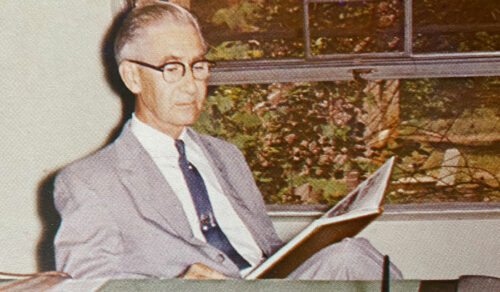
During WW II, Dr. C.E. Clevenger began a business school in Hickory. Starting with a student population of seven, he built enrollment to ten times that number within a year. It was only during his own enlistment in military service that numbers declined, but upon his return so did students. Once the federal government sanctioned Clevenger College of Business Administration as an approved educational outlet for G.I. Bill funding, numbers blossomed.
 In Hickory, Clevenger’s was originally located above the First National Bank building on Union Square. Enrollment grew to the point of twice being relocated. Eventually, the school was housed on the corner of 3rd Avenue NW and 2nd Street NW, where First Securities is now located.
After the war other branches of Clevenger’s quickly sprang up. In North Wilkesboro, a Dale Carnegie Class in Public Speaking grew into another campus with the help of the local Chamber of Commerce. The Lenoir branch opened in 1955 with an enrollment of 75. Additionally, locations in Newton, Marion, and Lexington in NC, Sumter and Lancaster in SC, St. Petersburg, FL and Norfolk, VA all had Clevenger outlets. Each campus welcomed both men and women.
 In keeping with the collegiate tradition, every year the school put out a yearbook they called “The Tyshac.” (no idea what that means) Within its pages were student photos, as well as faculty, along with captured images of campus life for both day and night students. Highlighted were clubs and fraternities, plus the results of voting on what was called school ‘superlatives.’ Recognition included categories like ‘most studious,’ ‘friendliest,’ ‘best looking.’ ‘neatest,’ and ‘most likely to succeed.’ A few branches even sported basketball teams that competed with local schools. In practical terms, Clevenger’s could be described as a forerunner of the community college system which was only beginning to ramp up by the early 1960s.
In March of 1962, tragedy struck. Dr. Clevenger died suddenly. If there was any doubt that he was the driving force behind his school, the subsequent decline of the campuses demonstrated just how much they relied on his guiding hand. By July of the following year, every branch of Clevenger College of Business Administration ceased operation.
Though Clevenger’s has been supplanted by other institutions of higher learning, many students from the war generation studied and earned diplomas in its classrooms. Its existence was an important step in the evolution of the towns Dr. Clevenger and his faculty served.
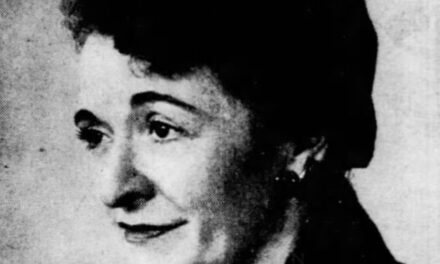
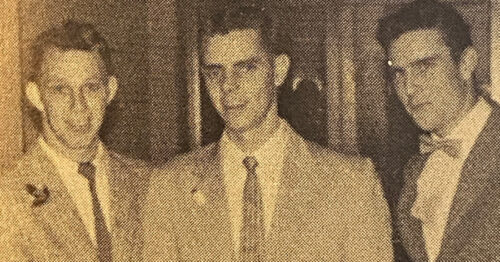
Photos: Dr. C.E. Clevenger, The 1959 “Tyshac” and members of the student body, one of whom was an earlier Richard Eller.