This summer marks the 111th anniversary of the start of World War I. It’s a bit of a hole in history, how the conflict, at the time called “the war to end all wars” is more or less forgotten. The sequel, WWII is much more widely known, studied and seen as a watershed for American society, which is perplexing, but understandable. The Second World War caused more destruction and took more lives than the first and remains a time when the world came its closest to destruction, via the atomic bomb. This summer also commemorates the 80th anniversary of that event, too.
WWI now is seen as a fight that is almost quaint by comparison. Neither side controlled a weapon that could wipe out a whole city, like was done to bring the Japanese to the surrender table in August of 1945. Forgotten is the fact that during the four years from 1914 to 1918, technology led both sides to conduct mass slaughter that shocked humanity. Mustard gas serves as a prime example, a chemical agent that poisoned the lungs of soldiers who breathed it. And that was not the only instrument of death.
Barbed wire, used in times of peace to keep livestock contained was also employed on the field of battle to snag onrushing troops, holding them so an opponent from within a trench had a good shot at them. Add to that the use of tanks, artillery with a range of 5 miles or more, and the early use of airplanes for reconnaissance and you have a battlefield unlike anyone had ever seen at the time.
In both wars, the United States attempted to stay neutral for as long as possible. What good would it do to spend American lives on a conflict between Germany and the rest of Europe? After all, the heritage of many living here had Germanic roots. In portions of Catawba County, some still spoke the tongue of the Fatherland in the privacy of their own homes, an example of how tied many were to World War I began an era for the United States that propelled it to world prominence. Prior, the U.S. was known for being an upstart against the British, winning two wars for its independence, then after taking land from its neighbor, got into a fight with itself. Few in Europe expected such a nation to develop an industrial capacity that could determine the outcome of their problems, twice.
Unfortunately, World War I really settled nothing and that may be the reason it has been shunted aside. Peace only fueled greater conflict as European peoples rebelled against Woodrow Wilson’s plan for them. He intended to “make the world safe for democracy.” Instead, a hot war was followed by two decades of a cold one that erupted again when Germany tried to take back what was lost in the Treaty of Versailles, the document that ended WWI, a treaty the United States never ratified.
Before World War II, it was known as “The Great War.” It’s is ironic that something seen as so horrible can be eclipsed by something that in comparison, was even worse.
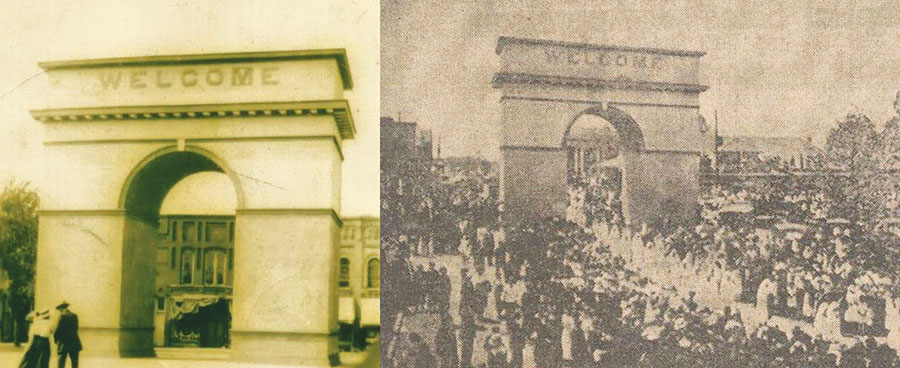
Photos: Down on Union Square, Hickoryites welcome back the soldiers of WWI with a model of the “Arc de Triomphe.” Images courtesy Hickory Daily Record and Historical Association of Catawba County.