
Moonshining has had a long and sometimes torturous history, here in the hills of western North Carolina. In the early days of the republic, every community had a least one whiskey maker, someone who knew how to distill good corn liquor. Today, we celebrate the skill it takes to make a smooth flavored spirit. In between, attitudes and law enforcement have frowned on the practice. Through the years, there have been a lot of good whiskey makers who, despite the rules, carried the tradition forward, sometimes to their own detriment.
Willard Watson came out of the hollers along Wildcat Road in Watauga County. He held a unique distinction. He was “the only person who had a license to run a moonshine still,” a permission given by the state of North Carolina.
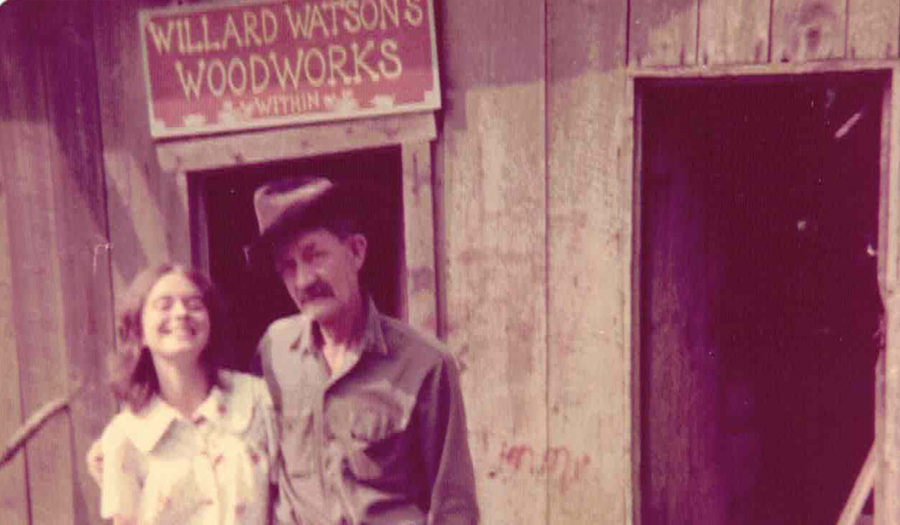
Willard’s third cousin, Linda Wilcox remembers him and while he didn’t speak to her much of his moonshining days, he was proud enough of the honor to mention it, even if there was a bit of a catch. As Linda recalled, he took a still he made “around to festivals and state fairs to show folks how it worked.” That was in the 1960s when the practice was illegal, so the still did not make real whiskey. It was all for show. In essence, all Willard was doing was boiling water, but at least government officials were beginning to recognize the public’s growing interest in how it all worked.
According to Linda, Willard Watson was a character. He told colorful stories, made toys from wood and played the banjo. Linda took her grandmother up to see Willard’s wife, her grandmother’s cousin. On those visits Willard entertained Linda by showing her the latest toys he had made.
During his day, Willard Watson became famous, not quite as famous as his first cousin, Doc, but famous enough to be featured on two episode’s of WBTV’s Carolina Camera. Correspondent C.J. Underwood asked him about his moonshining days. Willard claimed that he could distill a beverage that would “make you want to see your mother and shake her hand.” A long standing Watson family tradition, Willard’s skill at making a gallon of good corn liquor could earn him up to $25 a gallon, which today would equal almost $500. Using a 30 gallon still, each run could produce as much as 6 gallons. You can see why he got into it.
“If I can’t stay ahead of it, I leave it alone,” Willard told C.J. Underwood, showing a wise understanding and respect for the business of moonshining. He believed, “there’s money in making liquor but there’s the penitentiary in it, too.” Once he almost got caught. If he had not outrun the sheriff, he would have served time. That experience decided him to “leave it alone.”
For all his skills, Willard Watson has been recognized by Blue Ridge Music Hall of Fame and Blue Ridge Heritage. Some of his wood carvings are in the Smithsonian Institution in Washington, DC.
During his life, he exemplified the traditions of the North Carolina mountains. Linda said he always wished he could make one more (real) run. Thirty years after his passing, it might be possible. The world is slowly catching up to Willard Watson.
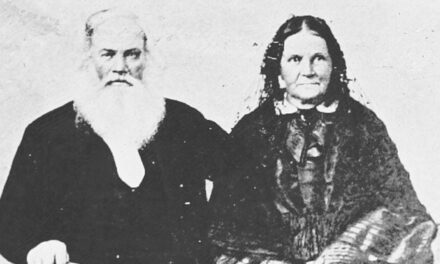
Photo: Willard Watson and his third cousin pose for a family pic in front of his workshop.