


One hundred years ago there was a college in North Carolina that had no commencement ceremony. The reason was that it had no graduates. Since only freshmen and sophomores were in attendance, no senior class existed for this institution of higher learning and therefore, no degrees were ready to be awarded. Why? Because the entire college picked up and moved to an entirely new campus fifty miles to the east.
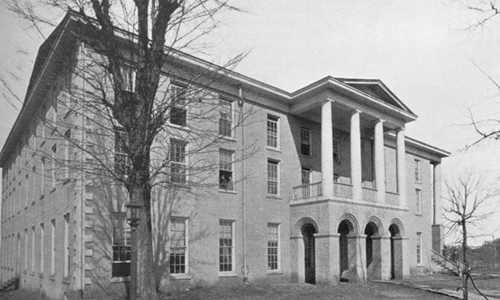
Photo: Newton’s Catawba College
Back in 1851, the German Reformed Church needed an institution to train young ministers for the pulpit. Catawba College was founded on a ten acre site just south of Newton as a perfect school for the job. Until the Civil War, the college grew suitably. Then, with manpower reduced by the war, the student body declined. Catawba struggled through the war and by the end of it became more of a high school for whomever showed up, a function that continued for the next twenty years.
By 1885, Catawba had regained its ability to teach on the college level. Five years later the school began to admit women to its student body, a very progressive move for the era. But over the years, Catawba College struggled with the problem of growth. There was never enough money to fund operations. Additionally, the ten acres had become confining. Other than one substantial building on campus, there was never enough room to grow and a neighborhood crowded its borders.
It all came to a head in 1923 as the leadership of the college began to look for alternatives. If Newton could no longer meet the needs of what had evolved into a fine junior college, Salisbury officials believed they had an answer. Offering more land and more buildings, some of them only partially completed, the college voted to relocated. The phrase they used repeatedly to underscore the need for change was that the new surroundings offered an opportunity to build Catawba College into a “Grade A” place of learning.
Newton folks were highly upset. In one editorial, the writer hated the idea and said “the dollar proposition was the wrong way to consider the problem.” He believed that the character of graduates should be considered above operational costs. “Better cut out this talk of moving Catawba College and go to work to make the college what it ought to be where it is.” His argument did not sway the decision. After the 1922-23 school year, the college packed up lock, stock and barrel to restart in Salisbury.
No students relocated, thus the school started a new student body from scratch. It took until 1928 for a group to matriculate through the college’s course offerings and become the first graduates of Salisbury’s Catawba College.
Back in Newton, the old building was eventually torn down. As I understand it, the only thing left is a set of steps that now reside in someone’s garden, the only artifact of Catawba College in Newton. However, one remnant remains. The street that runs through town to South Newton is still, to this day, named College Avenue.