

A hundred years ago up in the Appalachian mountains, a secret, known only locally, was building. Within two years it would explode onto the world, one that still reverberates. it began as an outgrowth of farm life. For centuries, families worked hard every day to coax enough food from the earth to feed themselves and the generations they were raising. At the end of the day or on Sundays, they would give thanks and entertain themselves by playing music.
The songs, many of them biographical, were stored up amongst the players as a kind of history book about who they were and what they, as a subset of Americans, had seen and experienced. Family harmonies was prized and into this culture came an odd trio of musicians.
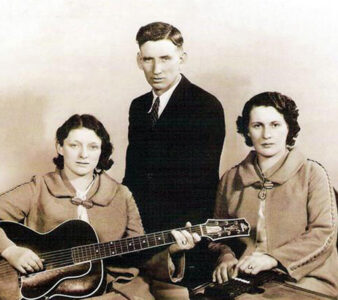
Photo: The trio. A clear voice, a genius on guitar and their cheerleader.
One was a restless man who wandered from holler to holler looking for new songs. He was married to a woman with a beautifully clear voice. In fact, that was one of the reasons he pursued her. In turn, she had a cousin who had learned the guitar (as well as other instruments) from her own mother and developed an intricate pattern for playing songs that looked deceptively simple. Connected as they were through family, the relationship would get closer when the guitarist married the brother-in-law of the singer. It got even tighter when the song chaser, the singer and the guitarist formed a group.
During the 1920s, a new technological phenomenon swept the nation: recorded music. Folks were no longer content to buy sheet music and play songs on the family piano. They wanted to wind up a phonograph, put on a platter and listen to the original artist play an original tune. Mountain folk knew, these were not original songs. They had been around for generations.
In 1927, the burgeoning recording industry and the musicians met. Ralph Peer, representing the Victor Talking Machine company came to Bristol, Tennessee/Virginia (the town straddles the state line) in search of acts to record. Dozens of musical combos trekked down from the hills to have their talent captured on disc. Among them were the three, the guitarist, the singer and the documenter of mountain tunes. Collectively, they were known as the Carter Family.
Alvin Pleasant Carter (A.P.) served as self-appointed leader. He urged his wife Sara and cousin Maybelle to take the 30 mile ride to Bristol so they could sing into the man’s microphone and see if their songs pleased potential record buyers. He borrowed the car of his brother (husband of guitarist Maybelle) to make the trip, and presented the music of Sara and Maybelle, then wandered off. The cousins were the real talent. Paid fifty dollars for each song they recorded, Ralph Peer found a sound that would become one of the bedrocks of country music.
What was it about the Carters that motivated the new record-buying public to want to hear the music over and over again on their Victrola? It’s tough to pinpoint. Perhaps it was the novelty of a sound many southerners heard at church and at barn dances, harmonies that express the loneliness and joy of life. A century later, we can still hear those same feelings.