

As we glide across whatever bridge takes us over the Catawba River, these are the days of convenience. At one time, the process of crossing was a much more complicated task. Just like livery stables, general stores, and blacksmith’s shops, the ferry demonstrates how much easier life has become.
The earliest migrants to the area followed animal paths to the river and forded at the shallowest sites. If you crossed, you got wet. It didn’t take long for enterprising settlers to invest in a drier and more convenient method of transportation, hauling passengers and goods ‘over,’ instead of ‘through’ the water. For a small fee, some farmers who settled on the riverbank rigged a mechanism to carry travelers across. Along the Catawba, seven ferries provided service at places that came to be known as Icard’s Ferry, Moore’s Ferry, Baker’s Ferry, Bowman’s Ferry, White’s Ferry, as well as Oxford’s Ford and Lookout Shoals.
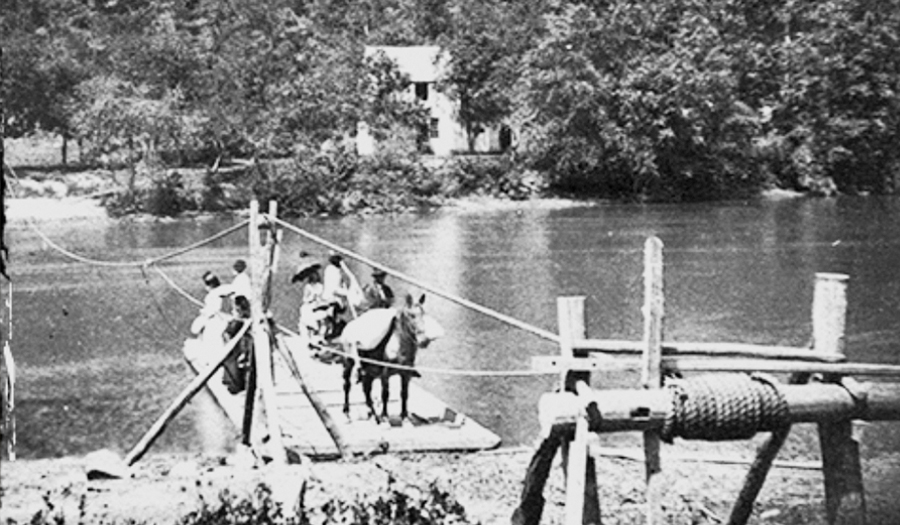
Here’s how they worked. A rope was strung across the river as a guide. Attached to it was a homemade flatboat, large enough to carry two wagons and their teams of horses. The boat could be pulled from one side to the other via ropes and a long pole used by the ferry operator to push the boat forward. Windlasses with a system of pulleys made the effort more secure, plus the technology of the time used the current of the river (this was before the dams) to help push the boat from one shore to the next.
The only hitch was hailing the ferry keeper. The towing of people and goods across the Catawba was a 24/7 job and since the family lived on one side of the river or the other, it might take hours to attract the attention of someone in the keeper’s household to come pick you up. The only thing you could do was be patient and yell.
Calling out until they heard you still consumed less time than heading to another crossing and starting the process all over again. “Hello” echoed up and down the river until a family member was roused, mounted the boat and crossed over to make the pick up. Think Uber or Lyft without the phone. If everyone was out tending to the farm, you just had to wait. In those days, nobody got to their destination in a half hour. It might take all day to travel to a nearby town.
Mishaps occurred. Sometimes a buggy driver, who might have had a drink or two, get the bright idea to depart early from the ride to avoid paying the fare. If his timing was not precise, he ended up in the river. Or, livestock that boarded the ferryboat might panic from the lapping of water on the side of the boat and jump ship. You paid your fee, you took your chances.
One midnight, a man was dispatched to Alexander County to pick up a corpse and bring the dead body back to Hickory. On his return, the driver claimed to be accosted by an owl, “who” pecked and hooted at him. The horses also panicked in the attack and with a coffin bouncing around in the back, the man, the horses and the deceased all barreled toward the ferry crossing. Though he tried, the driver could not stop the runaway wagon heading into the river and for a bit, the coffin floated. The only thing he could do was shout, “hell-oooo” and wait for someone to wake up.
Photo: A ferry operation.