
While April has a lot to recommend itself as the best part of the year with the coming of summer, it is also the month in which the Civil War both began and ended. North Carolina men were on both sides, with more Tarheel boys (a few women too) serving the southern cause than any other Confederate state. More died too, as well as had the most desertions.
Called upon to lead them all was Robert E. Lee. He took a rag-tag army in the summer of 1862 and turned it into a feared fighting force. While he did not win every battle, including his two invasions of the North, Lee got more out of his troops than anyone ever expected. With T.J. “Stonewall” Jackson and James Longstreet as key subordinates, the trio formed a partnership that left Lincoln and the entire Union army without effective measures to counter.
The battle at Chancellorsville serves as a key example. Called “Lee’s Masterpiece” it was actually the brainchild of Jackson, who suggested a flanking maneuver to get in back of Federal troops and rout them. The attack was a dangerous gamble. Had Union forces attacked as Jackson got his men into place for the late afternoon surprise, Lee was left with very little to counter. Luckily for Lee, Joe Hooker was not as aggressive as he bragged he was. Hooker claimed Lee had to give battle or “ingloriously fly” away. Instead, Jackson’s men showed up just as his opponents were laying down arms for supper. The assault was very successful, up to a point. Since it was early May (no daylight savings time), Jackson reconnoitered in the dark and was shot by his own men (18th North Carolina) and died a week later.
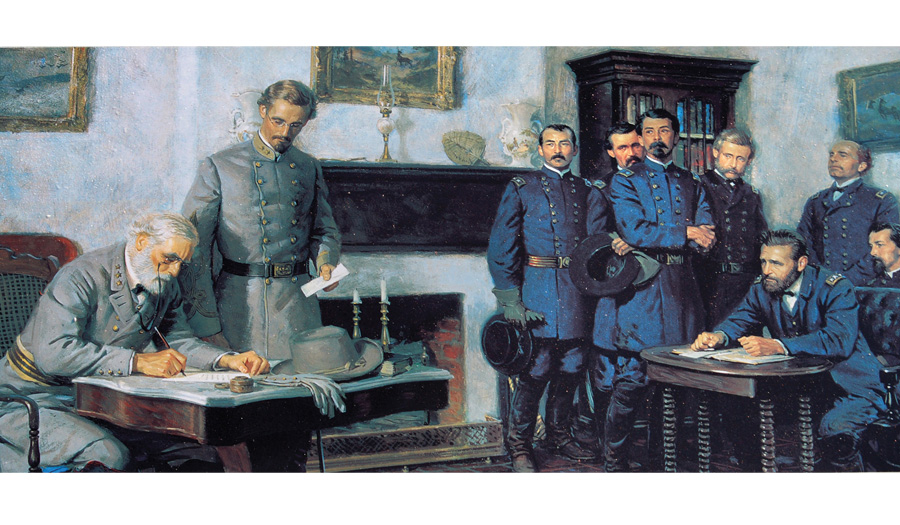
Photo: Lee and Grant make peace.
The tactical brilliance of that move has been repeated several times. MacArthur used it to get behind the North Koreans in 1950. Norman Schwarzkopf adopted it for Desert Storm.
After Chancellorsville, Lee’s Army lost its mojo. He stubbornly stayed at Gettysburg too long. After winning the first day, the Confederates did not secure the high ground and lost the second and third day trying to gain it. In 1864, Grant pushed Lee back toward Richmond where the Federals laid siege into the spring of 1865. Lee’s army was depleted to the point that they could only post resistance at a paper thin level. Grant broke through as the spring fighting season began, chasing Lee and his army to Appomattox.
On the retreat, Lee lost a number of his generals, as well as men, a far cry from how the war began. By that point, the southern cause had been exhausted. At Appomattox Court House, with his troops practically surrounded, Lee asked for terms of surrender.
Robert E. Lee has gone down in American history as an intrepid fighter. He did more with less than any other in the Civil War, but perhaps his best trait was in defeat. Though he said he would rather die a thousand deaths than surrender, he knew when to face the humiliation of losing and quit. In return, Grant showed great magnanimity, honoring the dignity of his fellow countrymen as they dispersed to their homes for the coming growing season.
The Union was reunited, at least formally.
Though in the 21st century Robert E. Lee has become a polarizing figure in American society, he was once quoted as saying, “it is good war is so terrible, else we would grow too fond of it,” explaining a soldier’s clear-eyed view of what made the game of battle a costly one. As Robert Gary Lee later said, “wisdom is nothing more than healed pain.” Here’s to hoping that on this anniversary, we are getting closer.