

The biggest event in American history of 100 years ago happened just across the North Carolina mountains in a small town in Tennessee that today is home to just over 7,000. If you’ve never heard of Dayton, that’s because its time has come and gone on the national stage. However, in the summer of 1925, this place reaped a whirlwind of publicity for a trial that city leaders themselves instigated.
The controversy started when the state of Tennessee legislated against the teaching of evolution, a scientific approach to understanding how human beings emerged to “subdue the earth.” It was a ‘new-ish’ alternate theory to that which is laid out in the Book of Genesis about the creation of mankind.
Local leaders thought the law offered a good way to promote their town. The logic rested on Dayton being the first place in the Volunteer state to test the statute. In doing so, they believed the publicity would promote Dayton as perhaps more progressive than it actually was. Local high school teacher John Thomas Scopes was approached to violate the anti-evolution law with the trial bringing media attention. Boy, did it.
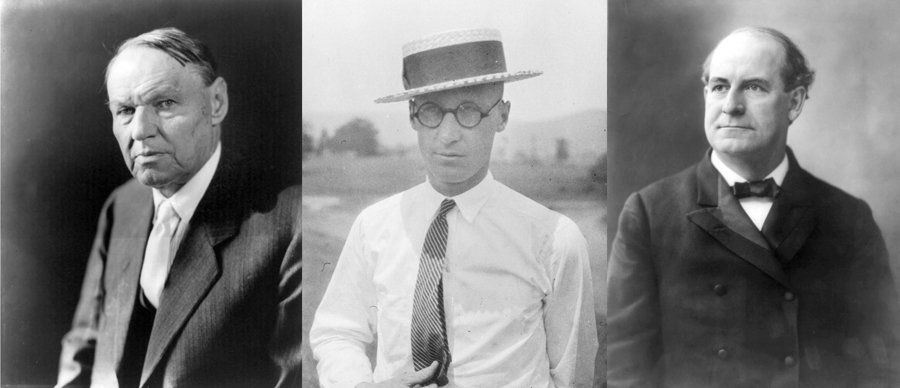
Photo: Darrow, left and Bryan, right with John T. Scopes caught in the middle.
A century ago, American demographics were changing. In the 1920s, the balance of rural to urban communities was tipping toward larger cities. That brought with it a mind frame different than their country counterparts. Rural folks lived much like their ancestors, getting what they needed on the farm. They were devoutly religious and wary of newfangled learning. Conversely, city people tended to embrace science as the savior of mankind, its new discoveries offering longer lifespans, along with modern conveniences.
Back in Dayton, as word got out about the test case, the nation began to take interest. Once the American Civil Liberties Union found out, they offered defense counsel to Scopes. Among them was a lawyer who would one day be known as the “Attorney of the Damned” (that’s the title of just one of his biographies). Clarence Darrow would become celebrated for his ability to litigate cases that seemed hopeless. He and a raft of attorneys traveled by train to Tennessee to stand for the defense.
The local prosecution got a boost from one of the most important political figures of the day, William Jennings Bryan. Back in 1896, he won the Democratic nomination for president at age 36, the youngest ever to do so. He pleaded eloquently for the rights of working Americans to have their interests represented in the national economy. He lost that election, as well as subsequent tries in 1900 and 1908, but he remained a powerful political leader. Bryan served as Secretary of State in Woodrow Wilson’s cabinet, an advocate of peace when the nation went to war in 1917. He quit rather than watch his country sacrifice American lives in a European conflict.
Bryan sided with conservative religious leaders about the teaching of evolution. He gave speeches on the subject, including an event at Brown University where he was booed. Undeterred, he came south to help make sure the state won its case against Scopes.
This bout between heavy-weight national figures set up a debate that remains a subject that we still have not adequately reconciled, new discoveries versus tradition. How it turned out a century ago? Next week.