
Did we evolve from lower life forms or is our existence the work of God? A century ago, that question was brought to trial over in Dayton, Tennessee. The religious community resoundingly contested the idea of evolution, saying man did not come from a monkey, which was how they defined that argument. Modernists believed the Bible much more allegorical than actual and looked for a scientific explanation of human origin.
In the summer of 1925, the battle lines were set in the Rhea County Courthouse in Dayton. At the twilight of his career, William Jennings Bryan represented tradition while Clarence Darrow, a lawyer who would one day be hailed as among America’s greatest defenders, stood for the defense of science.
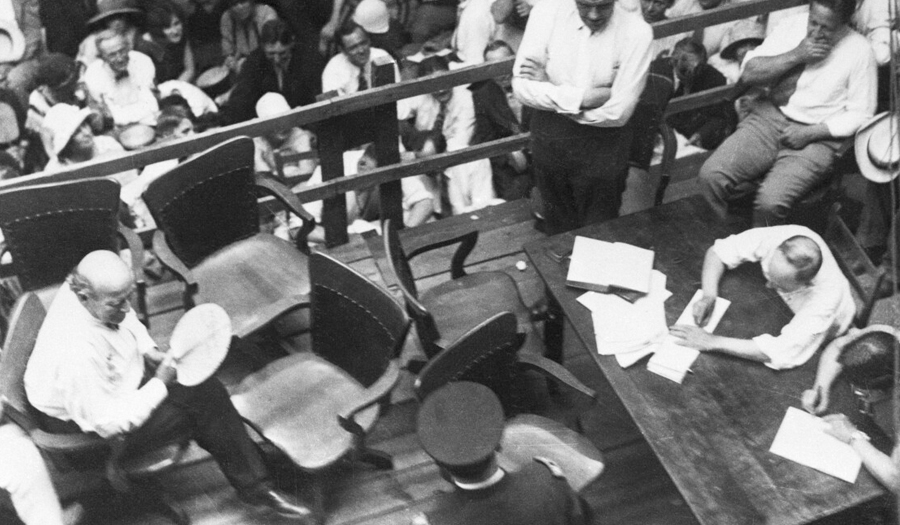
Was John T. Scopes guilty of teaching evolution? Yes. At that point, the matter was cut and dried. However, the media circus that emerged around the case wanted answers to bigger questions. Everyone knew that, given the players involved, the event would put both modernism and tradition on trial. Spectators filled the courtroom to the point that the second story floor started to creak and the whole thing had to be moved outside. Interest was so great that the proceedings were broadcast nationally, on radio.
The whole affair got interesting when Darrow put Bryan on the stand as an expert witness on the Bible. He badgered the man they once called the “Boy Orator of the Platte” (a reference to his Nebraska upbringing) with questions about the vagueness of the Genesis story. Were the days of creation literally 24 hour days. If Adam and Eve were the first persons on earth, where did Cain’s wife come from? When Bryan could not supply definitive answers, Darrow pointed to the inability of the scriptures to invalidate the theory of evolution.
The prosecution won the case but damage had been done to the national psyche, as well as to William Jennings Bryan. A few days after the verdict, after Darrow was back on a train to Chicago, Bryan died in his sleep in Dayton. On appeal, the conviction was overturned due to a technicality.
The case though, brought a debate to the forefront, with both an urban and a rural point of view. How might the United States of America go forward? Would it embrace science at the expense of belief, or would the country remain traditional in its outlook, as previous generations had thrived upon? As with most things, the Scopes Monkey Trial ultimately provided no conclusion. It was just an early skirmish in the culture wars.
Photo: The climatic outdoor proceedings in the Monkey Trial, Darrow questions Bryan.