
That is not a recipe for summer. Though, it could be. Instead, it is the nickname of the ET&WNC Railroad. The East Tennessee & Western North Carolina Railroad, to be more precise. You may still not know it. Try this one. Tweetsie.
Before it was a theme park, Tweetsie was the rail line that ran between Johnson City, TN and Boone, NC. The name came from the sound of the whistle as it echoed off the mountains on its daily run.
The railroad began as a project of the New South. After the Civil War it became apparent that the only way the South was going to recover was by industrializing. In the 19th century, life was speeding up and trains (though slow by our standards) was the fastest way to get raw materials to factories and subsequently, the output of those factories to buying public.
State legislatures threw money at anyone intrepid enough to try building a rail line. In the case of the ET&WNC, the first attempt ended up in failure. The original builders ran off with the money. So what did the Tennessee General Assembly do? They funded another try, one that actually laid track.
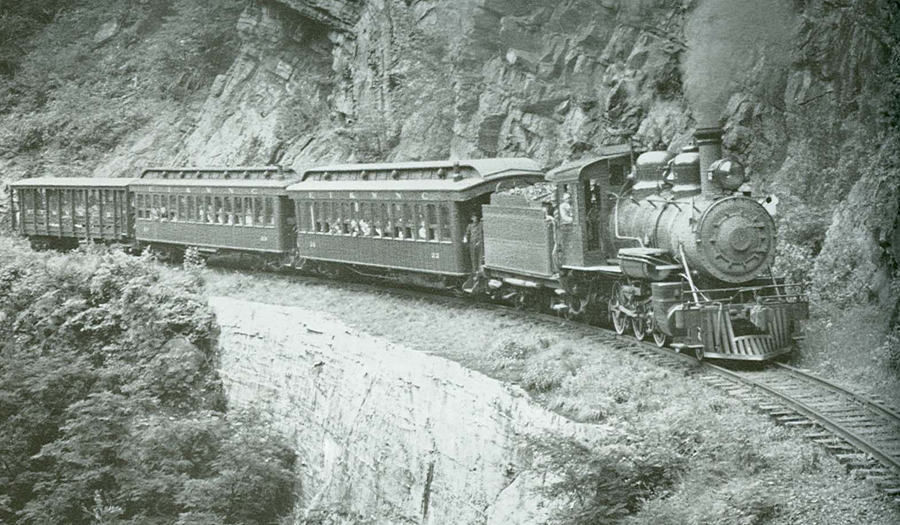
Photo: The original Tweetsie line chugging around the mountains of East Tennessee and Western North Carolina.
Constructing a railroad through the mountains was a daunting task. Steam-powered locomotives couldn’t handle much more than a 4 percent grade (meaning a four foot rise for every hundred feet forward) so the project took years. Finally, in 1918 the train rolled into Boone.
As the 19th turned into the 20th century, Tweetsie hauled iron ore out of Cranberry, lumber from the portable peckerwood sawmills that spawned the western NC furniture industry and passengers, helping to populate out-of-the-way mountain towns and enhance Boone’s biggest attraction, Appalachian State Teachers College, now, AppState.
Tweetsie was an economical effort. As a narrow gauge railroad, the rails were only three feet apart, as compared with a standard gauge line of 4 feet, eight and a half inches. In practical terms, that meant the rolling stock (engines and the cars it pulled) were smaller, easier to build a roadbed for, especially around mountainsides, and cheaper.
Mountain folk loved their railroad. Their more formal name for the ET&WNC was “Every Time and With No Complaint.” But just as surely as technological change brought Tweetsie to the mountains, so did automotive culture. By the end of World War II with newer, more versatile ways to get goods to market, Tweetsie was scrapped. That is until an enterprising businessman by the name of Grover Robbins had a bright idea to bring Tweetsie back to the mountains in a different incarnation.
Next week, how the Old West came to the Appalachian mountains.