

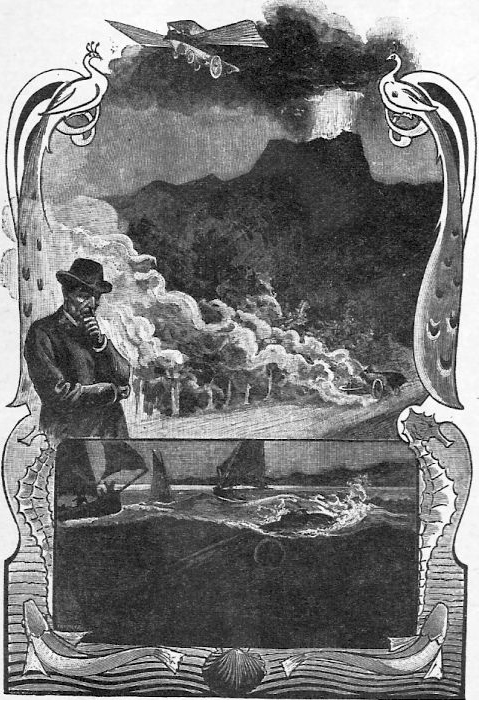
Photo: Inner sleeve of Verne’s Master of the World
He looked across the Atlantic from his home in France and found… Morganton. I’m talking about Jules Verne. Yes, the same man who wrote Twenty Thousand Leagues Under the Seas and Around the World In 80 Days chose to set his last novel near Morganton, North Carolina.
The book was called Master of the World, a sequel, and it was the last novel during his lifetime from the man known as the “father of science fiction.” In his time, the works of Jules Verne were translated more than William Shakespeare’s. As the title might suggest, Master of the World offered a very pessimistic view of the future as Verne used its main character and villain, Robur the Conquerer to warn readers about the rise of authoritarianism in the coming twentieth century from the perspective of 1904.
What does all that have to do with the Brown Mountain Lights? Plenty. In the book, Robur is based inside the mountains near Linville Gorge. Apparently, the story of the lights had reached Verne and he was keen to use the phenomena as an element in the cautionary tale of a secret empire, built by Robor, in the effort to take over the world. The lights came from the spacecraft that lurked under the surface, ready to take flight when the seizure of power took place.
As with a fictional story, a few geographical facts gets mixed up. Table Rock and Brown Mountain are confused. He calls them both Great Eyrie (Mount Airy?, you know, from where Andy Griffith came), plus a few other things of which Verne took poetic license to build the setting. As with science fiction, his predictions of the future were not borne out with time. He has a transportation source that worked on land, sea and air (we haven’t invented one of those yet) and he believed that the faster it went, the less heavy it became, defying physics.
Master of the World never became one of Jules Verne’s best sellers. His others, 20,000 Leagues, 80 Days and Journey to the Center of the Earth sold much better. However, the story ultimately got made into a Hollywood film starring Vincent Price. The screenplay was penned by Richard Matheson, a later sci-fi writer, known for his work on The Twilight Zone, as well as I Am Legend. In an interesting way though, Jules Verne used the Brown Mountain Lights to highlight an imperative issue he believed threatened early 20th century America, a fear that has come around again and again.
One other adaptation of the lights also bears mentioning. In the early 1950s, Scotty Wiseman wrote a song about the Brown Mountain Lights. It became popular locally as Tommy Faile sang it on the WBTV-Charlotte morning show and issued it as a single. You won’t hear it very often these days because in the song, he explained the lights as the manifestation of one ghost, looking for another. The lyrics: “A faithful old slave, come back from the grave, is searching, searching, searching for his master who’s long, long gone.” See why?