What do Langston Hughes, Zora Neale Hurston, F. Scott Fitzgerald, Ernest Hemingway, Ezra Pound, Virginia Woolf, Samuel Johnson, T.S. Eliot, George Bernard Shaw, and Oscar Wilde all have in common?
They were all regular attendees at literary salons.
The word “salon” goes all the way back to a proto Indo-European word meaning house or dwelling. In 16th century Italy it was used to refer to a large receiving room, a room for holding parties and entertaining guests, what most of us commonly call a living room today. Then, when sisters-in-law Isabella d’Este and Elisabetta Gonzaga, written about in Baldassare Castiglionein’s “The Book of the Courtier,” began to host in their large living rooms gatherings of artists and intellectuals for the free exchange of ideas in a relaxed, informal environment, the word began to be used in reference to regular gatherings of that sort.
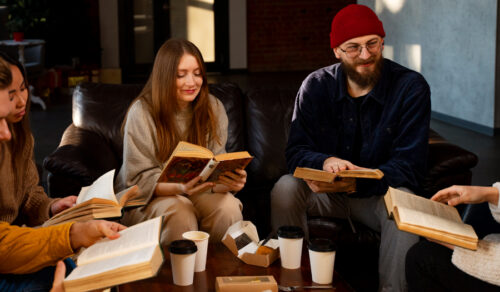 The salons most commonly thought of when that term is used historically are those popularized in 17th and 18th century France. The first of these was hosted by Italian-born French aristocrat Catherine de Vivonne, Marquiese de Rambouillet, in the Chambre Bleue of her home, the Hotel de Rambouillet in Paris. Equally well-known was Gertrude Stein’s “Saturday Evening Salon” (described in Hemingway’s “A Moveable Feast” and portrayed in Woody Allen’s film, “Midnight in Paris”), which hosted Hemingway, Eliot, and Picasso, among others, and is often given credit for being the birthplace of the literary movement known as modernism.
Salons by other names, however, have existed at least since the symposia of Ancient Greece and in the pre-Islamic Middle East when, for example, the poet, Al Khansa would stand in the ‘Ukaz market in Mecca reciting her poetry and inviting intellectual discussion, leading to the emergence of literary criticism among Arab women, which subsequently took place in their homes. In ancient Rome these discussion groups often took place in tonstrinae, public barbershops where men would linger to discuss politics and current events, which may be why the word “salon” eventually was also applied to haircutting places, and why we still think of such places as centers of gossip (remember the Clairol cliché, “Only my hairdresser knows for sure”).
Salon-type gatherings have occurred in a variety of settings across the centuries. Coffeehouses in 17th and 18th century England, for example, were often called “penny universities” because they served as centers for intellectual discourse on science, philosophy, politics, literature, and current events. Such use of coffeeshops resurfaced during America’s Beat Generation, and they continue to be popular locations for poetry readings, artist receptions, business and political meetings, non-profit endeavors, and other intellectual activities today.
Scottish, Welsh, and Irish pubs have served similar purposes for centuries. Poetry and music in Irish pubs date all the way back to ancient Irish bardic traditions and has continued into the 20th century with writers like James Joyce writing songs for drinks in Mulligan’s Pub and immortalizing Davy Byrne’s Pub in “Ulysses.” Robert Burns and Robert Louis Stevenson were known to draw ideas and inspiration from the characters and camaraderie they found in Edinburgh pubs. Dylan Thomas met with his Kardomah Gang in the No Sign Wine Bar in Swansea. And while not a pub-frequenter in his native Ireland, Yeats, when he lived in London would meet his Rhymer’s Club at Ye Old Cheshire Cheese Pub on Fleet Street.
Of course, not all salons have been literary in nature. Some have consisted of musicians, visual artists, thinkers, actors, or people from diverse careers who share some common interest. Salka Viertel, for example, hosted a salon in Santa Monica in the 1930’s and 40’s commonly attended by a diverse group of European expatriates including Greta Garbo, Charlie Chaplain, Bertolt Brecht, Aldous Huxley, and Albert Einstein, among others. And a century earlier, Charles Babbage hosted “scientific soirees” attended by Michael Faraday, Charles Darwin, and Ada Lovelace.
So, why all this history of salons? Because starting January 20, Hickory will take a dip into history by beginning to hold its own literary salon. Yes, of course, as the definitions above have made clear, there have been salons of various sorts (writers’ groups; artists’ gatherings; coffeeshop, pub, and barbershop chat sessions; house concerts; etc.) in Hickory for as long as there has been Hickory, but this one will specifically be called a salon, The Hickory Poetry Salon.
The gatherings will take place from 6 to 8 on the third Tuesday of each month at Patrick Beaver Memorial Library and will be facilitated by me, for now, Hickory’s Poet Laureate. While I have plenty of ideas of what I think we should do, including prompts, critiques, discussion of particular poems, poets, poetic ideas and opportunities, what exactly the salons will consist of will largely be determined by the particular interests of those in attendance. The hope is that this open-ended monthly gathering will give anyone interested in poetry the opportunity to discuss, learn, exchange ideas, draw inspiration, and meet others who share their interests. In my 40+ year teaching career I have frequently had students tell me they wish they knew how to keep the experience of classroom discussions of poetry going after they finished the class. Well, this just might be how.