

 This winter, the electric grid has been on the minds of a lot of folk. In bad weather, how reliable is it? Will it hold up to really cold weather? Questions like that.
About a hundred years ago, the conversion was on. Americans were moving to electricity, from open fire heating, either a fireplace or a centrally located coal or wood stove inside the home. More and more consumers warmed up to the idea of plugging in and enjoying instant convenience. Flip a switch and the room was bathed in light. Plug in a fan and enjoy a cool breeze, or pop some bread in a toaster and have breakfast, if you were too busy to fry some bacon on the stove, which was also standing ready.
Especially after World War II, people embraced the use of electricity as an absolute necessary. Every six to seven years, the need for electric power doubled in the United States. By 1955, estimates were that in the next ten years, the power grid would have to double in size. And that is where Catawba County enters the picture as a player in mix.
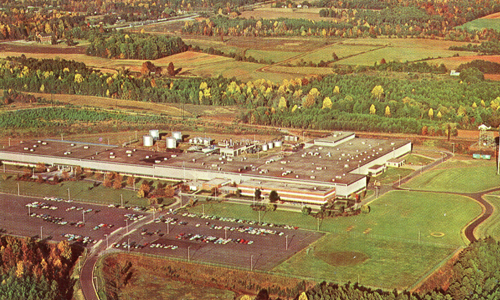
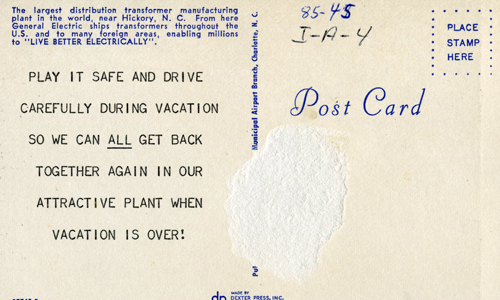
Seventy years ago, General Electric Corporation built a new plant right where Hickory, Newton and Conover meet, along Fairgrove Church Road. The new 400,000 square foot facility made transformers, those bucket-looking things that hang from the sides of power poles. These devices are used to reduce the voltage for consumer consumption. In 1956, it cost $20 million to construct the new plant, equivalent to over $240 million now.
At the time GE was a huge conglomerate. The transformer plant was the 133rd industrial unit for the company and the fourth in North Carolina at the time. GE made lamp wire in Goldsboro, light fixtures in Hendersonville and electric blankets in Asheboro, but the Hickory facility was different. It wasn’t subject to the buying needs of the public; they made an item that powered all other products, and therefore recession-proof, or so they thought.
 In the mid 20th century, the trend was to move industrial plants south to take advantage of a labor force that worked for less. Already, GE had a transformer plant in Pittsfield, Mass. Company officials swore the new Hickory enterprises was not a “runaway plant,” meaning that the factory was an addition, not a substitution and running away from the Northeast just to save a buck.
For almost 20 years, the GE plant buzzed with activity. Always a good contributor to the community, personnel played key roles in the growth of Catawba County in that era. In fact, GE public relations head, Tom Dana, Sr. was instrumental in getting started a county wide, training facility that could serve the interests of GE as well as every other industrial training need in the area. What started as the Catawba County Industrial Education Center eventually became Catawba Valley Technical Institute, then Catawba Valley Technical College before assuming its current status as a community college.
At one point, GE was the largest employer in Catawba County, with over 1,200 workers. The facility also demonstrated that the county could attract industries other than furniture and textiles. Those were the good days for GE in Hickory/Conover/Newton. Next week, the reason there is no longer a transformer plant in Catawba County.
Photos A postcard of the 17 acre GE campus on Fairgrove Church Road, along with a safety message. (Images courtesy of the Historical Association of Catawba County)