

A century ago, Charles Lindbergh was celebrated beyond anyone else. His flight across the Atlantic from NY to Paris was hailed as an unparalleled achievement when he made the trip in 1927. The year before only around 6,000 people in the U.S. took an airplane flight. The year after Lindbergh’s feat, that number grew to 180,000. That’s how much attention he brought to air travel.
His daring accomplishment inspired songs, dances, as well as a whole generation of kids who wanted to go into aviation, just as Lindbergh had promoted during his tour of every US state after he got back from Europe. He was mobbed wherever he went. The public could just not get enough of Charles Lindbergh.
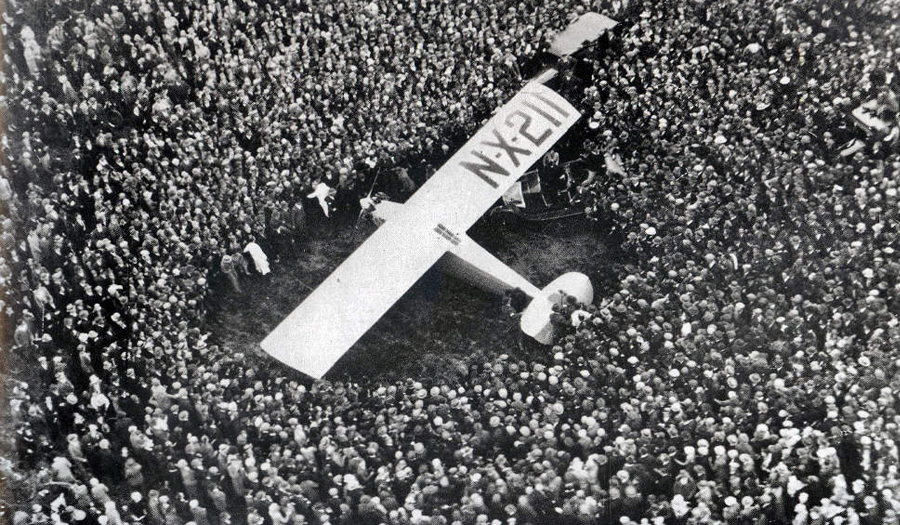
Photo: Lindbergh mobbed. One day the crowds would walk away.
Then the sinister side of fame reared its ugly head. By the early 1930s, Lindbergh was married and starting a family. On March 1, 1932, Charles Lindbergh, Jr., just two years old was kidnapped and ransomed. Lindbergh paid $50,000 to get his son back but that never happened. The body was found not far from the family home. A nationwide search of the marked bills used in the ransom led to Bruno Hauptmann. He was tried for kidnapping and murder, found guilty and executed, though subsequent investigations have questioned the accuracy of the verdict in what was dubbed, “the trial of the century.”
During the rise of Nazi Germany, Lindbergh was a guest of the Third Reich. He received medals authorized by Hitler and even espoused Anti-Semitic views, along with siding with the isolationists in the “America First” campaign to keep the US out of a war with Germany. For that, his reputation began to deteriorate. President Roosevelt no longer trusted Lindbergh and when the war came, kept Lindbergh from assisting the war effort.
In addition to his American family, Charles Lindbergh had others. It was later discovered that he was the father of seven children with three German women. Right up until his death he wrote them trying to keep the secret. After his passing it all came out. In addition to his Nazi sympathies and his pre-WWII isolationism, the reputation of Charles Lindbergh had greatly shifted in the 50 years since he became the idol of millions.
The life and career of “Lucky Lindy” as they called him after the historic flight reveals an interesting phenomena about mankind. When someone comes out of the blue to the attention of the public, many are quick to jump on the bandwagon of fame. They find the accomplishment inspiring. As time passes though and with the same individual put on a pedestal, the attitude changes. Instead of exulting their genius, the public takes a different kind of mob mentality to seek demise of the same person.
It seems that we see what we want to see. When a new star rises, the blinding light of accomplishment is all the public sees. Upon closer inspection, the flaws start to appear and the impression changes.