
Degrees help. Teaching others helps. Publication helps. Publishing a book helps even more. Getting a good review, more still. Winning an award, of course that helps. Publishing 25 books, 2000 poems, 500 essays on poetry, all support the supposition. Teaching hundreds of students across 40 years, dozens of them even getting their own books published, absolutely helps.
But still you feel anyone can tell you that because you’ve never written a good sestina, you’re not a real poet, and they’d be right. Or anyone listening to your poem and telling you they don’t get it, is because it’s not good enough. Or because your poems do or don’t rhyme or because your name isn’t Robert Frost, you’re only pretending.
Poet Imposter Syndrome. The bad news is it never goes away.
The good news is you’re not alone. There is not a Poet Certification Board that stamps your passport with the title, Poet, making clear your identity as such to any who question the validity of your claim. There is not a degree (MP, Master of Poetry, or PCD, Poetic Content Doctorate) to put after your name. There is not even a standardized test to take to qualify and rank your abilities. So, every poet, regardless of experience, success, number of years pursuing poetry, still, at times, sometimes all the time, feels they may be an imposter.
The better news is if you’re writing what you consider poetry, then no one can really tell you you’re not a poet because just as the nonexistent Poet Certification Board can’t validate you, it also can’t deny you.
And then, best of all, maybe the nagging feeling that you’re just pretending to be a poet is part of what drives you to keep writing after decades of trying, of making time to write despite the constant demands on your time and discouragement from doing something as frivolous as writing poetry; decades of being satisfied with the words rather than focusing on the lack of compensation or appreciation; decades of recognizing you really don’t have any choice anyway, and none of what’s missing in your life as a poet is really what matters anyway.
I arrived at these conclusions recently (or again) when I came face to face with someone else’s Poet Imposter Syndrome. Here is the poem the experience resulted in, a poem not only full of truth, but also a true story.
Office
An old friend, a good writer,
author of 12 collections of poetry,
comes into my coffee shop and asks
to speak to me on the side.
He wonders if I have ever reached a point
where I couldn’t write. I tell him, Sure,
we all do, and after a couple of weeks
the panic sets in and we fear what we’ve done
is all we’ll ever do, but then
something happens and it starts again.
He says, “Yes, but I haven’t written anything
in a year and a half. I don’t see anything
worth writing about, and when I do
get something down, it never seems any good.”
I tell him, Writing is a way of seeing
and it sounds like you’ve been wearing blinders.
I ask him, Whoever said it had to be good?
I tell him, Go someplace new
with no agenda but to write what you see.
I tell him, Start with any stupid prompt,
like “Three men walk into a bar; what happens next?”
I tell him what he has forgotten,
There is so much to write about every day
that you can never finish your job.
When he leaves, I go in the back and sit
in the black wooden chair between
the #10 cans of tomatoes, the gallons
of olive oil, the cases of industrial sized
trash bags and pull out the box top
I sometimes use for a desk, and write this poem
with gratitude to my friend for giving me something to write.
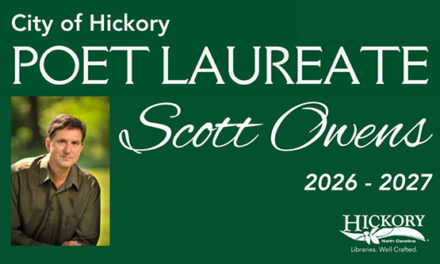
Scott Owens is Hickory’s first Poet Laureate, author of 25 collections of poetry, and professor of poetry at Lenoir Rhyne University. His columns are archived at www.scottowenspoetry.com.