

In the poetry world, Michael Hettich is a big deal.
His collection The Halo of Bees: New and Selected Poems won the 2024 Brockman-Campbell Book Award for the best book of poetry published by a North Carolina poet that year, as determined by the North Carolina Poetry Society (NCPS). His 2021 The Mica Mine won the Lena Shull Book Award from NCPS. His 2013 Systems of Vanishing won the Tampa Review Prize for Poetry. And his 2011 Measured Breathing won the Swan Scythe Press Poetry Award.
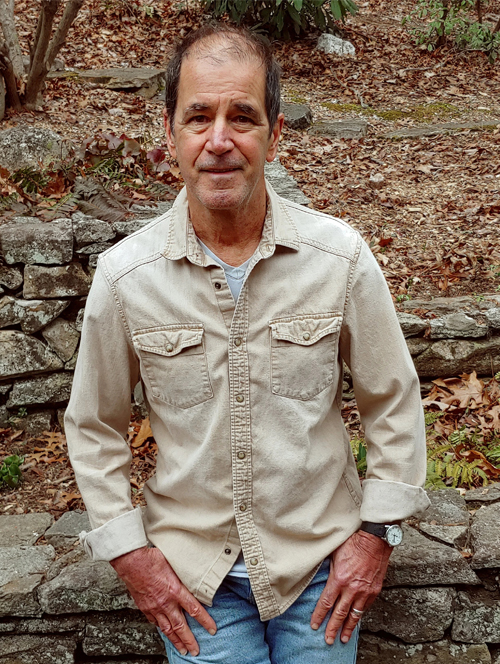
Michael Hettich
Nearly all of his 16 books have won one award or another. Most recently, his latest, Waking Up Alone, has won him another Lena Shull Award, making him the only person to have ever won that award twice.
That’s a big deal.
I recently read Waking Up Alone, and it may very well be the most moving and impressive collection of poetry I’ve read in the last 20 years. The book is essentially an elegy for his wife, Colleen, who passed away in early 2025 after a long struggle with cancer. It is also an elegy for the relationship between Michael and Colleen. It is also a celebration of the person Colleen was and the experiences the two of them shared.
Yes, that’s a lot for a single volume of poetry. But that’s not all.
It is also an ars poetica, a poem about the craft of writing poetry, a manifesto of sorts that says, “This is how you do it.” In the opening poem, The Meadow, Hettich gives a glimpse of a mindful existence that quietly celebrates perception, recognizes the complexity and vitality of a moment, and appreciates all that it contains. Then, throughout Waking Up Alone he not only continues to demonstrate this practice but also occasionally consciously coaches us on how to achieve it, “The trick is, the truth is, keep looking, take nothing / for granted. / Don’t live / in a daze of expectation.”
Expressing and utilizing this approach is not new for Hettich. In a previous essay/poem in the journal Mudbank, as well as in conversations with his students during his 40-year teaching career, he referred to it as “wild mind” or “feral mind.” I would describe it as an associative-observant-narrative state, a sort of oxymoronic intentional unmindful mindfulness that is both “in” the moment, thus open to experience and perception, and “outside” the moment observing and collecting details, feelings, connections, and “seeing” the story that unites all of it into a single momentous event. I think it is likely the goal of every poet, and not something many of us ever manage, or at least not for very long.
In Waking Up Alone and in the 50-page title poem, Hettich does.
I recently had the great pleasure to chat with Hettich on a Redhawk Publications RedPubPod podcast. You can listen in on the Redhawk YouTube page at https://www.youtube.com/watch?v=RZ5rwI_hHi8&t=2335s. And on March 17, Michael will be our very special guest at the Hickory Poetry Salon, where he will read a few poems and chat with attendees, starting at 6 PM at Patrick Beaver Memorial Library.
Here is his poem, The Meadow, which I mentioned earlier and which I consider to be more beautiful than anything I can imagine ever writing myself.
The Meadow
I woke in a tall-grass field at first light
and listened to the birds, and hummed with a dream
I made up from wisps
that ran through my body
shivering marrow, making me notice
the dew that dampened
my face and the spider webs
starting to shimmer the trees.
Everything was breathing; the long night echoed
in the dawn-light; stars
and vast migrations
as the breeze stuttered a moment, then stilled.
Across the field, my companion was singing
her own perfect song, which was silence. Still
I could hear her somehow, so I got up and set off
to than her for sharing this beautiful place
she’d known all her life, this place where she’d always
felt happy, the place she yearned to stay
as long as she breathed. And then, she’d told me,
she’d turn into something more perfect: the vast
sky, so blue it hurt the eyes,
or a meadow like this one, that stretched to the horizon.