

 Yes, it is over. The quarter-millennial celebration of the nation signifying 250 years of experience is over. In fact, we can now put the anniversary behind us for another half century, until the tricentennial comes up in 2076, five decades from now.
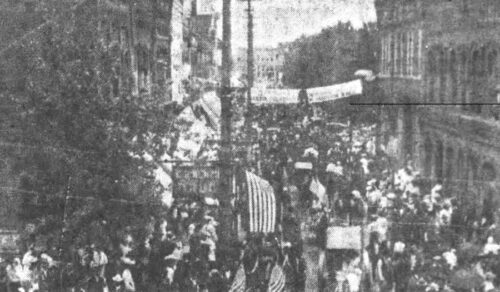
Locally, a lot of fireworks, some cookouts, a few ceremonies, and sweating out the holiday this year marked the 4th’s most recent passing. For Hickory, it may not have come close to past commemorations for the crowds. Looking back, a few photos bring reminders of how folks used to celebrate the day down on Union Square.
Hickory was nothing like Vicksburg, Mississippi where citizens refused to honor the day because former Confederates saw the 4th as a glorification of the federal government who forced the city to surrender on July 4, 1863 during the Civil War. For over 80 years, they didn’t forget. It took the end of World War II to bring back the holiday.
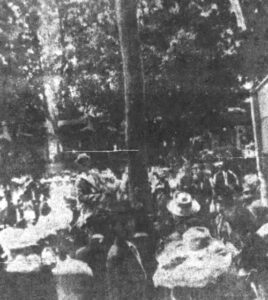 Instead, the city of Hickory welcomed celebrants downtown every year for lots of flag waving. If Confederate veterans objected, they kept their disapproval to themselves. Townsfolk joined in on a party that was crowded and memorable enough to have photos taken. Since the town was perched on Bolick’s Dry Ridge and the highest peak westward until reaching Marion, it had mountain vistas to see on three sides, north, west and south, which made it a vacation spot during summers in the 19th and 20th centuries. With an occasional breeze to be enjoyed, the temperature generally reached only into the upper 80s.
In the first photograph, dated around 1903, banker Wade Shuford leads the procession atop his horse as a grand marshal for the annual parade. Shuford, one of the owners of the Brookford Mill, exemplifies the most prominent of Hickory citizens, a town that prided itself as a community on the move. Shuford and his fellow business leaders were always promoting the town as a place of opportunity.
In the second, taken a dozen years or so later, folks have again turned out. The flag of the nation now sports 48 stars after the inclusion of Arizona to the Union. At the time, Union Square was capped by stores on both the eastern and western end, with the railroad line firmly planted (as it remains today) on the south side (to the right). Once again, a parade is in progress. This image was thought to be taken by pioneering Hickory photographer C.M. Hardin (a book of his images was recently published by Redhawk Publications) from the vantage point of the second floor of the Shuford Hardware store building.
These images, though somewhat clouded by time and technology, give us a look into how previous generations enjoyed their 4th of July, in some ways very different from the way we just recently did it. But in other ways, much the same.
Photos: Hickory in 1903, A crowd on Union Square in the days before the automobile took over. (Images courtesy HDR)