
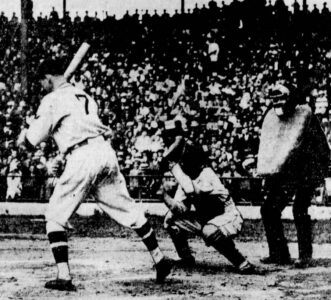
Photo: Alabama Pitts, at bat in his professional baseball debut.
One summer night in 1941, a guy walks into a bar in Valdese. The beer taps are flowing regularly and the man imbibes a bit more than his share. Emboldened by his buzz, Ed Pitts looks across the dance floor to find a young lady with whom he would like to ‘shake a leg’. He goes up to her and attempts to ‘cut in.’
The woman’s date objects. Instead of some prolonged argument, the date takes out a knife and takes a swipe at Ed, cutting him across the right arm. One witness swore he could hear the blood of the victim hit the floor. Friends of the victim attempt to staunch the flow by applying a tourniquet. Unfortunately, the first aid did not help and by the time an ambulance arrived to take Ed Pitts to the hospital, he had bled out.
The slaying became front page news in papers all across the country. The incident was noteworthy because Edwin C. Pitts was much better known as “Alabama Pitts,” a nationally known baseball player.
Pitts was born in Alabama, thus the nickname as a way to differentiate him from his father, who was born in Georgia. After a stint in the U.S. Navy, the younger Pitts robbed a grocery store in New York, taking $76 in the haul. For his crime, Alabama Pitts was sent to Sing Sing Prison. During his 5 year stretch, prison officials used team sports as a way to rehabilitate prisoners. There, he gained the attention of baseball scouts after demonstrating his athleticism on a team known as the Black Sheep.
Upon his release, Pitts signed a contract to play major league ball. However, officials tried to keep him from playing, believing the public would not want to see a convicted felon on the diamond. However, baseball commissioner Kennesaw Mountain Landis was inundated with telegrams which convinced him to overrule the decision and Alabama Pitts’ popularity soared. For the next six years he played for a variety of teams. He even tried football, playing halfback for the Philadelphia Eagles.
In 1936, Alabama Pitts came south to play for the Charlotte (baseball) Hornets. He was also in the lineup of the Gastonia Spinners, the Valdese Textiles and Lenoir Finishers, all teams in the Carolina League, which was known as an outlaw league since it allowed players to join after breaking contracts in other leagues. He also swung a bat for the Hickory Rebels in 1940.
Pitts was a very good fielder and a decent batter. During his season with the Hickory Rebels he hit .303. By 1941 though, his abilities were deserting him and he was playing for a semi-pro team while also working for a textile mill in Valdese. One headline read “Alabama Pitts, Famous Convict Athlete, Killed.” During his lifetime, two Hollywood films were based on his story and reportedly, over 5,000 people attended his funeral, which was held in Fallston, where he is buried.
The man who stabbed Alabama Pitts also went to jail. He served only two years after the governor of North Carolina pardoned Newland Lafevers, considering the slaying as an act of self defense.