
Theses days, farming runs on the exorbitantly priced commodity of diesel fuel. Machinery helps farmers get the most out of each acre and since fewer of us grow any of our own food, we are dependent upon them to supply whatever we buy at the grocery store.
A hundred years ago, the story was quite different. Those were the days when farmhouses were the nerve center of the family farm, surrounded by several hundred acres of “cultivated fields, and woodlands.” That’s how Frank Poovey described his grandparents family farm, located “just two miles north of the town of Hickory.”
In 1965, Frank looked back on what even then was a bygone lifestyle, the family farm. He noted that the family farmhouse was located smack in the middle of “a complete complex of various farm buildings that made it a small village of almost self-sufficiency of its day.” By our standards, the place might seem unlivable. “No electricity, no running water, and no built-in automatic heating system.”
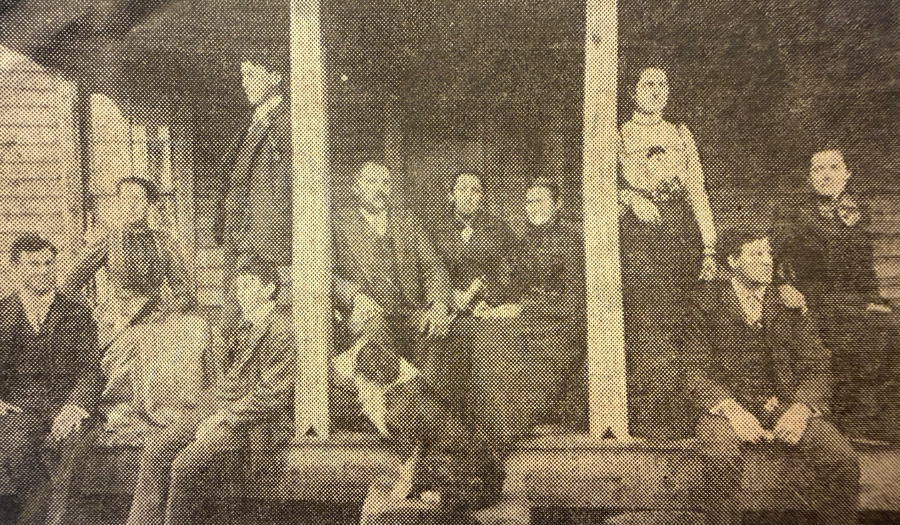
Photo: The Poovey Family, in their Sunday best for the photo, nothing like what they wore when farming chores called. (Image courtesy Hickory Daily Record)
Everything ran by human or animal power. With chores ever-present and numerous, family members acted in a cooperative communalism that made sure plenty of firewood had been cut for stoves and fireplaces and fresh water from the well was on hand for drinking, cooking and cleaning.
It is ingenious how folks from a century ago worked around what we might call hardships. Harvests of foodstuffs required canning which were then stored in root cellars (storage sheds dug underground, usually into the side of hills). Commodities like milk that needed to stay cool were stored in earthen crocks and kept in cool streams (if one was available) or in troughs with water hauled in. If, by chance the milk were to sour, it could be “poured through a cloth stainer and made into cottage cheese.” If at all possible, they wasted nothing.
Fire provided heat in the winter and light for lamps at night. By those lamps, folks mostly read “the Bible, the Salem Almanac and the Progressive Farmer (magazine).” Just about every house had a piano in those days and with some accompaniment, like guitars, fiddles and banjos, families made their own music.
For most, like the Poovey clan, the central area of the house was the dining table. Meals were served there but many conversations were also held there. That’s also the spot where children were planted for “studying their lessons.”
The house had a “parlor” but that was used for special occasions like visitors on Sunday. On the wall might be an image or two of family member whose likeness was captured on film, or perhaps painted. The family Bible would be enshrined there, that was valued almost as much for the genealogical information that had been written in it, as for the gospel it contained.
It was a different world that Frank Poovey recounted from his days as a “farm boy.” Simple, laborious and somewhat disconnected from the outer world, farms of the old days offer a lifestyle that doesn’t depend on the price of diesel fuel.