
The summer of 1780 was a low point for the Patriot cause around here. British cavalry commander Banastre Tarleton had just overseen a battle at the Waxhaws where Patriots were slaughtered when they were trying to surrender, labeling Tarleton a butcher. In addition, Benjamin Lincoln, for whom the county of Lincoln and the town of Lincolnton were named had surrendered the city of Charleston, South Carolina in May. It looked as if the British strategy to win the war by sweeping up from the South was working. With Georgia and now SC under control, NC was next.
John Moore was one of those loyalists who fought on the winning side at Charleston. He returned to his Lincoln County home full of tales about the siege that took the South’s largest town away from the Patriots. Along with news of his exploits he worked to rally loyalist neighbors. Cornwallis was coming and soon, they would be able to participate directly to defend the Crown against rebels in the area who sought independence.
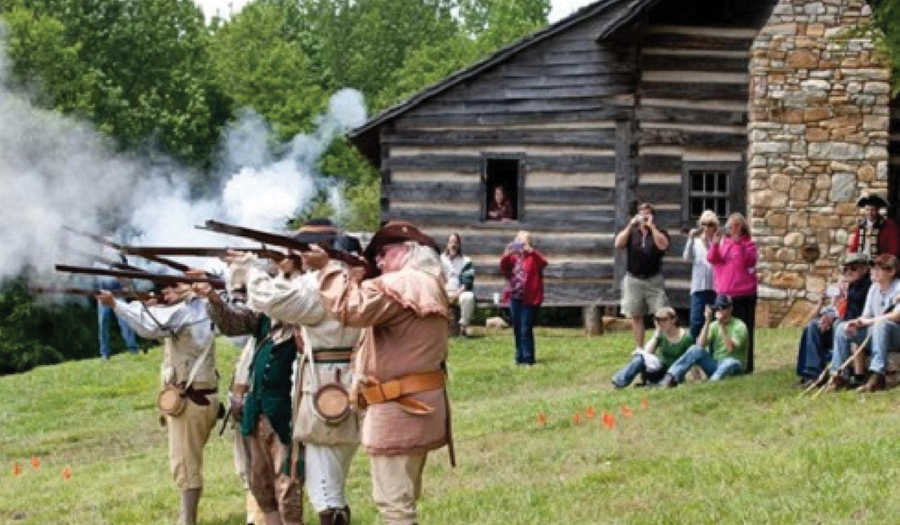
PHOTO: A reenactment at Ramsour’s Mill will take place at the battlefield (Lincolnton High School) on June 20-21.
Patriot General Griffith Rutherford heard of Moore’s efforts. He contracted Colonel Francis Locke, who was camped down on Mountain Creek, to gather as many men as possible to oppose Tory (loyalist) recruitment efforts. He and about 400 troops, some without muskets, headed toward Moore’s home near Lincolnton. Rutherford was on his way too but would arrive too late to be of much help.
Moore had done much better recruiting. He had almost 1,300 men, more than tripling what was coming at him. In the predawn hours of June 20, 1780 a battle erupted. Fog obscured visibility but within about 300 yards of Ramsour’s Mill, both sides began firing at each other in an exchange that had no British soldiers (except Moore) nor American Continentals. It was just neighbor against neighbor, wailing away at each other.
The struggle go so intense that once ammunition was all used up, the combatants began swinging their muskets like clubs to attack each other. With no uniforms to be seen, loyalists put a sprig of green in their hats to identify themselves to each other, while Patriots put white paper in their brim. Brothers opposed brothers in the melee that lasted for over two hours.
Despite Colonel Locke’s attempt to retreat and reform his men for a desperate attack against an outnumbered army, Patriot Captain John Dickey refused to give any ground. In the din of battle he shouted, “Shoot straight my boys and keep on fighting. I see some of them beginning to take a tumble.” Finding higher ground, the Patriots began picking off Tories, forcing the loyalists to surrender.
The outcome of the battle was significant though losses were about equal on both sides. Any Tory support for the Crown in this region dwindled to almost nothing. Meanwhile, the Patriot cause found a much needed win. That fall, some of those same Patriots gathered to oppose another foray of Cornwallis’ thrust into the region, at a place called KIng’s Mountain.