

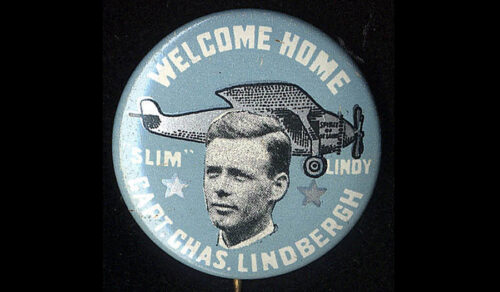
Photo: A button heralding Lucky Lindy
Next year marks the centennial of one of the most celebrated feats in American History. In its time, the accomplishment was a stupendous as a trip to the moon and similarly, involved some intrepid soul, leaving the bounds of the earth to do it. In 1927, Charles Lindbergh crossed the Atlantic to make the first flight from North America to Europe.
Not quite. It had been done before. Back in 1919, a Brit and a Scot had flown from Newfoundland to Ireland. They won a cash prize for their efforts, but following that, a New York hotelier, Raymond Orteig offered $25,000 for anyone who could go from New York City to Paris, or vice versa. Several tried, some even died in the attempt. Then came Lindbergh.
Charles Lindbergh was a shy kid from Minnesota. He grew up fascinated with machinery and quit college to learn how to fly. He became a stunt pilot, barnstorming towns with an aerial show that wowed the public demonstrating barrel loops, wing walking, all the stuff that excited a paying crowd. He also flew for the Postal Service carrying air mail. Then he decided he wanted to compete for the Orteig Prize (in today’s dollars worth just under a half mil).
Nobody knew who this guy was so finding backing for the trip was not easy. He finally got two St. Louis businessmen to take out a loan to sponsor his attempt, that’s why he named the plane the “Spirit of St. Louis.” Originally, the plan was to buy a plane and fly it, but limitations soon became apparent and Lindbergh co-designed an aircraft that would get him “over the pond” as the British like to say.
On a rainy Friday morning, May 20, 1927, Charles Lindbergh took off. In building the plane he jettisoned anything he thought unnecessary, like a radio. The night before the flight he got very little sleep because of nerves. On takeoff, he barely cleared the power lines at the end of the runway as about a thousand spectators watched him leave, either to his own demise or the pages of history.
For the next 33 and 1/2 hours Lindbergh guided the Spirit of St. Louis in an east-northeasterly direction. Through fog, ice, and uncertainty he flew, occasionally falling asleep but ultimately relying on his piloting and daredevil experience to drive him toward his destination. Once he found the coast of Ireland, he perked up, knowing the City of Lights was within reach. He needed those lights too. After sunset, he reached Paris not knowing exactly where the airport was. He circled the Eiffel Tower three times trying to figure out where to land when he saw a tremendous amount of light in the direction of the Le Bourget Aerodrome (the airport) and prepared for landing. Over 150,000 people were waiting. They mobbed him as soon as he landed. Instantly, Charles Lindbergh became the most famous man in the world.
He returned to the United States an international hero. Paid to fly to every state in the Union (48 at the time) he flew into Winston-Salem, where gave a speech on the bullish future of aviation. Upon leaving the bandstand, spectators tore it apart to have a souvenir of the platform on which Lindbergh stood. That’s how idolized he was, a celebrity forever more.
Don Henley once sang the line, “I don’t know why fortune smiles on some and lets the rest go free.” Next week, the downside of being Lindbergh.