

In the days before the internet, or television, or even radio, retailers needed to attract customers. Did you know that “the best 50 cent shirt in the World” could be found “at J.C. Martin’s White Front,” in Hickory? As strange to modern ears as that sounds, you read it right.
John C. Martin took the liberty of attracting folks to his clothing store by differentiating it from the rest of the businesses on Union Square. He whitewashed his brick storefront and then proclaimed it to everybody in his advertising. Officially, it was known as the “White Front Clothing Emporium” owned by Martin and his partner, O.M. Royster. To draw attention to the establishment J.C. made sure that no shopper could mistake it for any other retail outlet.
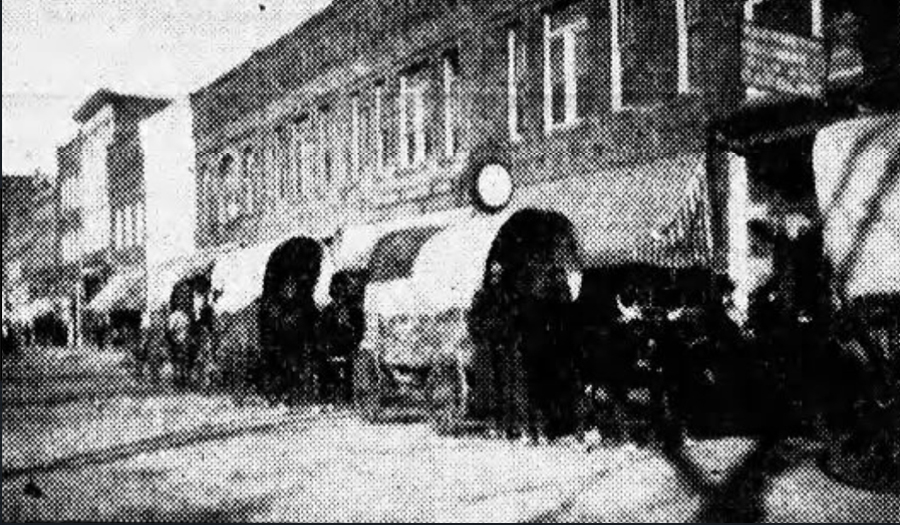
Photo: Union Square in the 19th Century. Notice the White Front down the line.
As potential customers entered town from the north, along what they then called the river road, Martin persuaded a local resident to let him emblazon the side of an old covered wagon and his carriage shed with messages about the “White Front” Store in boxcar-sized letters. The ploy worked.
J.C. Martin was busting at the seams to market the clothing store ever since he was a paid employee of the company, first owned by Fred Hill. Partnering with local drug store owner O.M. Royster, they bought the store. Martin got some of his ideas during his travels to New York City as a buyer. He watched the way it was done in the big city and implemented similar strategies back in Hickory.
Some even credit him for giving Union Square its name. While in NYC he heard and apparently liked the term, Union Square. He added it to all his advertising. The designation for the downtown business district became popular that it has stuck ever since. Some point to a second rail line in Hickory, creating a union of two railroads, but either way Martin’s advertising helped cement the designation.
Martin proved to be a consummate marketer. Out back of the White Front store, he personally welcomed trading travelers who were bringing in wagon loads of produce, down from the mountains and up from Charlotte. He offered a place to park for the night in exchange for a little advertising space on their wagon. J.C. Martin even painted the signs himself.
He engaged in other stunts, too. Once, the White Front distributed hand bills, advertising a “live boy in (the front) window” of the store. The boy was of course, attired in the best of what Royster and Martin had to offer. In that same front window, the store marketed a “feather weight umbrella” by putting it on a scale opposite a few turkey feathers to show high light it was. The feathers hid lead weights.
Perhaps his most outlandish effort was his “hat scramble.” Again, using hand bills, Martin announced that a portion of his hat stock (some had gone out of style) would be tossed out the upper windows of his building. If you were there and one floated down to you, you could keep it, for free.
Without mass media to attract customers, J.C. Martin got creative and found inventive ways to get folks in his store, 19th century style.