
The bright, shiny hopes held by the British to squash the rebellion of its colonies started to deteriorate after Kings Mountain. Killed at that battle was one of its most promising officers. What was left was an overconfident commander (weren’t they all) and his ruthless subordinate, ready to teach a bunch of backcountry primitives a lesson about loyalty to the empire of the United Kingdom.
The ruthless subordinate, Banastre Tarleton had been very successful as a cavalry commander, ordering his troops forward into uncertain situations, sure that his audacity would turn every skirmish in his favor. He was on the lookout for upstart Patriots, especially those who cut down his comrade Patrick Ferguson, who’s body still resided under a rock cairn on King’s Mountain.
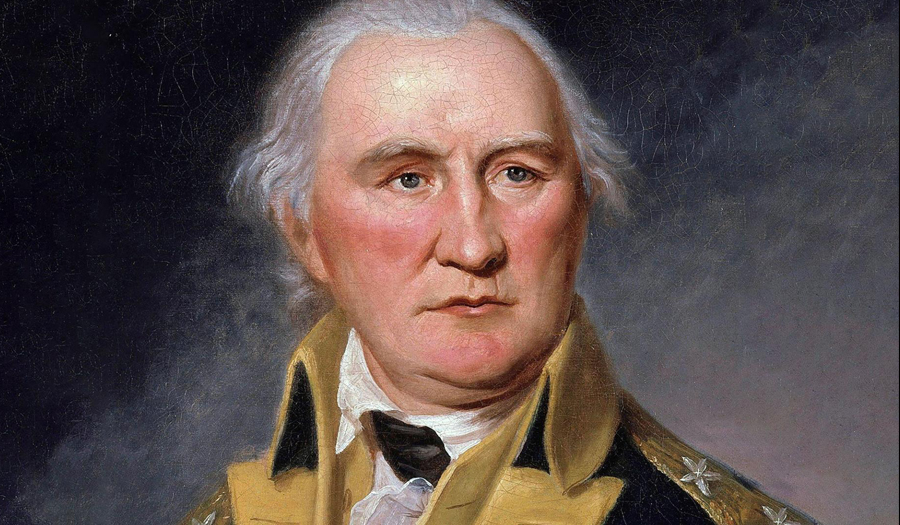
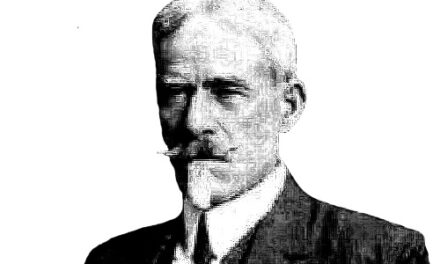
Photo: Daniel Morgan. Yes, the seat of Burke County is named for him.
Newly promoted leader of the southern Continental Army, Nathanael Greene had other plans. Selected by none other than George Washington himself to take over after Horatio Gates turned chicken at Camden, Greene talked the Old Waggoner, Daniel Morgan out of retirement to help bag Tarleton and his roving band of Brits, who were intent on scarring the countryside into putting down their arms in support of the Crown.
Morgan was becoming an old man, wracked with ailments including sciatica. He did not want to be on the field of battle. But a loyalty to the cause kept him in service. He had one last engagement left in him. Greene wanted Morgan to keep Tarleton’s Legion occupied but did not seek a stand up fight, fearing the Patriots would lose. Morgan had other ideas.
Rambling around northern South Carolina, Tarleton picked up Morgan’s scent. With the overflowing Broad River too much to cross, Morgan decided to turn and fight. The plan involved turning Tarleton’s strength into a weakness. On the night of January 16, 1781, Morgan gave a pep talk to his militia. He told them that one day, with grandchildren on their knee, they would be telling the tale of how they repulsed Tarleton’s Legion with two shots.
The militia had a reputation for retreating before ordered to do so. Morgan wanted to turn that weakness into a strength. He told them when they saw Tarleton coming headlong for them to fire, reload, then fire again. After that, they were to retreat to a line in the rear, behind Continental troops. Plus, Morgan has another little surprise for Tarleton. On the wings, out of sight was waiting William Washington’s (George’s cousin) cavalry, who would envelope the legion.
The plan worked to perfection. Morgan baited Tarleton into a headlong rush that he could not get out of. With sabres drawn, the British cavalry fought for their lives against the sack Morgan put them in. Cowpens was a staggering victory for the Patriots.
With a few months, the Patriots had turned the tide of the war. The southern strategy was a flop. Cornwallis took back over personal command, chasing Morgan as best he could. In fact, the British commander spent three days in Lincolnton, trying to decide what to do. He decided to shed his army of most of its gear in order to be light enough to run down the Patriots. Next week, another culminating battle that helped the British decide to let the hornet’s nest of the southern colonies alone.