

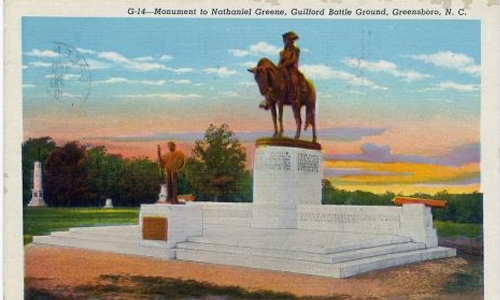
Photo: Postcard from the Battlefield. The Nathanael Greene statue from Guilford Courthouse.
The outcome of the battle of Cowpens stunned Lord Charles Cornwallis. He lost a quarter of his army, his surest subordinate was humiliated and the southern strategy was falling apart. The British general vowed to follow Patriot leader Nathanael Greene and his “army to the end of the world” if he had to. Remembering the earlier disaster at Kings Mountain only made Cornwallis more angry about the turn of events.
In chasing Greene, and Daniel Morgan, architect of the brilliant battle plan at Cowpens, the British commander decided to play the game their way. He got rid of all the baggage trains that slowed his army down, thinking his men could live off the land or enjoy the bounty of loyalists, whom he expected to encounter in great number. The Redcoats and what few loyal Tories he could find, chased the Patriot army into North Carolina, itching to draw them into an open fight where Cornwallis knew his trained troops held the advantage.
Greene raced to get his men across the Dan River, just over the state line in Virginia as a barrier to the British thrust. “I am not without hopes of ruining Lord Cornwallis,” Greene said, “if he persists in his mad scheme of pushing through the country.” Greene waited, looking for an opportunity to give battle on a site of his choosing.
The idea of divesting himself of troop supplies wasn’t working out for Cornwallis. News of British cruelty toward Americans fueled not only desertions but dried up the hospitality of those who otherwise might have provided the King’s men with food and assistance. Cornwallis desperately wandered around the piedmont looking for a place to fight before his soldiers starved.
The clash came on March 15, 1781. Greene used a version of the same battle plan Daniel Morgan so expertly conceived at Cowpens. Morgan was gone, back home in Virginia, suffering from exhaustion and persistent pain from sciatica. Like in Cowpens, Greene employed the militia as his first line of defense. These Patriot farmers, turned soldiers, did better than expected, holding their ground through several volleys.
The second line was a mix of militia and Continental troops. They poured a galling fire into the oncoming British. Behind them was a third line of all Continentals, well-trained men from the 1st Maryland and Delaware, some of the Patriots’ best.
The interesting thing about the battle was how Greene won without winning. At the end of the 90 minute engagement the Patriots withdrew, giving the British the field and by some accounts, the win. However, in securing the field near Guilford Courthouse, Cornwallis lost a quarter of his army. Banastre Tarleton was wounded in the melee and the commander had no choice but to march his limping army to Wilmington for resupply. Greene took comparatively few casualties. Like he was fond of saying, “We fight, get beat, rise, and fight again.” On the other side, British spectators had a different view. “Another such victory would ruin the British Army,” was how Charles James Fox, member of Parliament described the Battle of Guildford Courthouse, meaning in supposed victory, the Brits lost more than they gained.
The battle was just another nail in the coffin of British hopes to reconquer the colonies. It began to occur to the British and their allies alike that maybe this rag-tag gang of Americans could actually back up the words of the Declaration of Independence with action on the battlefield.