
July 1776. Yeah some things were happening in Philadelphia but down here in what was then Rowan, now Catawba County, a not-so-friendly neighborhood war was in full bloom. Folks were choosing up sides on the matter of independence and were ready to kill over it.
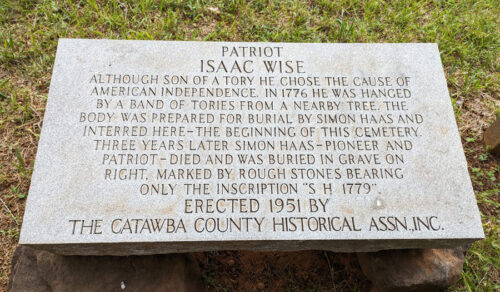
Photo: The grave of Isaac Wise (Image courtesy of the Sons of the American Revolution).
Some believed turning against the most powerful nation on earth was folly. Britain protected the American colonists from the French (a service for which we did not ask) in the most recent conflict, the Seven Years War, know on this continent as the French and Indian War. Since the British had spent something like 123 million pounds in the effort, (equivalent to $67 billion today) the government felt the Americans should pay a fair share, thus a variety of taxes on the colonies followed. Those constituents who were willing to pay those taxes, called Tories or Loyalists constituted about a third of the population.
Those opposed and in support of the work of the Second Continental Congress in Philly were known as the Patriots, sometimes called Whigs, a holdover term from the English Civil War, signifying those opposed to the tyranny of the king. They were roughly equal to Tories in strength and were vocal in taking up arms in favor of a new nation.
The last constituent group was on the fence about the whole thing. Having not chosen a side, these folks took a ‘wait and see’ attitude about the war, preferring a more prudent approach while assessing if the long shot of independence stood a real chance of succeeding. Times were tense as neighbor spied on neighbor, ready to coerce if not kill over the choices made. In fact, some made their choices based on how others came down on the issue, a kind of “my enemy’s enemy is my friend’ approach.
The partisanship was unlike any the settlers had ever seen before in western North Carolina. That summer of 1776, feeling ran so hot that a young boy by the name of Isaac Wise, around 17 years old, defied his father and committed to fight as a Patriot. Daniel, his father could not dissuade his son and when fellow Tories captured Issac and threatened him with execution, the young man refused to relent. The local Tories sentenced him to death by hanging.
Apparently, no one was prepared for Isaac’s stand. They had no rope with which to carry out the deed. A loyalist by the name of Martin Shuford remedied the problem by riding off to find some. He did, but upon his return fell from his horse and broke his nose in the fall. From that point on he attained the nickname of “crooked nose.” Shuford ultimately died from a mortal wound during the battle of Ramsour’s Mill, four years later.
The whole affair took place south of Newton on the property of Simon Haas, who cut the young Patriot down and buried him. In 1951, the Historical Association of Catawba County erected a marker to commemorate Isaac Wise. It’s a bit tough to find, but it’s there.
Some have compared him to Nathan Hale who also was hanged for his Patriot loyalties. Only difference is that Hale was captured as a spy and though he expressed from the gallows regret that he had only one life to give for his country, that incident took place several months after the hanging of Isaac Wise, an American Patriot who gave everything he had for the cause.