
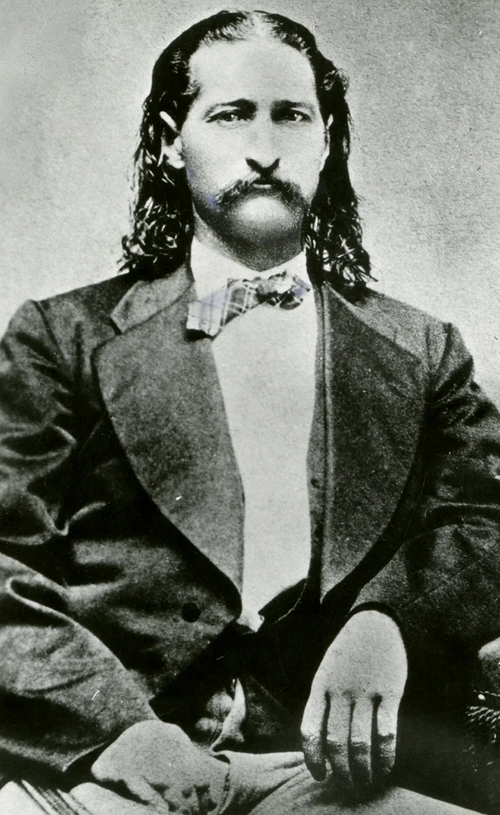
Photo: J.B. Hickok or “Wild Bill” as we know him.
Last Sunday, a guy walks into a bar. He notices a game of poker going on and asks to sit in. With the only chair available leaving his back exposed to the door, he considers his options. Should he take the seat, refuse to join or ask another player to switch chairs? After two refusals to move by the others, he uneasily sits down for the next hand. For reasons that will soon become obvious, he takes the only chair that gets him in the game.
After a few rounds, the man with his back to the door, draws two pair, aces and eights. He smiles at the thought of betting his cards, anticipating the pot this round might bring. Fixated on his hand, he doesn’t hear another man walking in, heading toward his table. For that matter, none of the other players do either.
As the foursome focus on the cards they were dealt, the stranger raises a pistol to the back of the head of the man playing ‘two-pair’ and shoots him in the back of the head, shouting “take that.” The victim falls head first on the table, a smile still on his lips, dead. Before the round can conclude, the most famous poker game in history has just taken place.
The incident occurred 150 years ago, on August 2, 1876, in the gold mining camp of Deadwood, South Dakota (a territory at the time). The victim was James Butler Hickok, better known to American history as “Wild Bill,” a gambler, but also a lawman, scout, actor and gunfighter. The perpetrator, Jack McCall had most recently lost all his money to Wild Bill in an earlier game and though the victor gave McCall money to buy a meal, the gesture was taken as an insult. Repayment came in the form of a bullet.
Anyone drawing a similar cards to Wild Bill’s, all-black “aces and eights,” knows it as the infamous, “dead-man’s hand.” Nobody knows what the fifth card was. The incident has gone down in history as an example of the turbulent times in the “wild west.”
Hickok, a man who killed at least six others with (at times) questionable motives is himself the receiver of frontier justice. There is a certain kind of, if not satisfying karma that went with the shooting, an ironic twist that alway makes actual events the basis by which we understand the human psyche. As someone once said about history, ‘you can’t make this stuff up.’
When added to all the other strange events of American history, this event reminds us of the fact that people acting out of impulse drives humanity. No matter how much we tell ourselves that we are getting more civilized and rational, we are not. Insults, petty feuds, retaliation are as much a part of everyday life as it was 150 years ago when even Wild Bill did not see it coming. On that hot August afternoon something more than his own safety, which he had protected rigidly up to that point was overwhelmed by the lure of a good game of cards, an impulse for which he paid dearly.
That’s what makes reading American history an ever-enlightening pursuit.