
 Last week’s tragic mid-air crash in Washington, D.C., is a reminder of how precarious flight can be and brings back the day it happened here.
Just after 1:00pm on April 20, 1960, a Wednesday afternoon, two planes approached the Hickory Airport. One was a private plane, a Cessna 310, the other a Piedmont Airlines F-27, among their newest and sleekest planes. Both pilots had been warned of the presence of the other and both operated by Visual Flight Rules.
It just so happened that Robert Houston was perched on the roof of Winkler’s Grove Baptist Church and found himself in an eyewitness position for the event that was about to take place. As he looked up, he noticed the two aircraft converging. “The small plane moved over the top and I saw the propeller blade of the Piedmont plane chop off part of the wing. The plane bobbled a couple of times then fell straight to the ground at an angle with the good wing pointed straight down,” he told reporters.
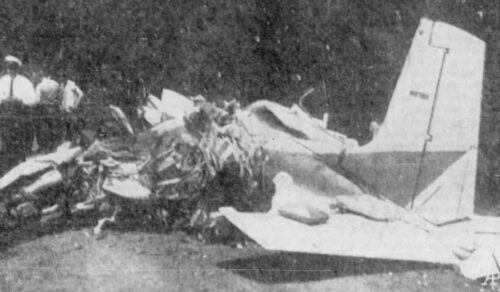
The four passengers on the Cessna died upon impact. They were flying into Hickory for the semi-annual furniture market being held that spring. Aboard the Piedmont flight, passenger Ed Manske noticed an “abrupt jolt with a lot of noise.” No one saw the smaller plane hit Flight 50 as it descended toward the runway, about 600 feet in the air.
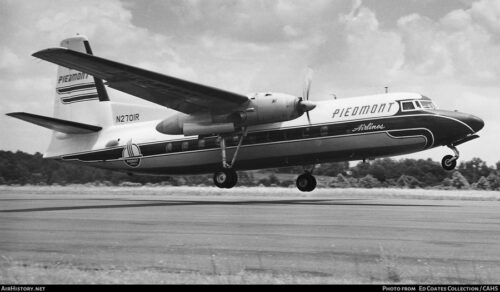 Flying Piedmont’s Palmetto Pacemaker that day was Captain Lee Cottrell. He was in the process of pulling up the nose of the plane, only about ten seconds by his estimation, from landing. Cottrell and his First Officer Pete Dickens brought the Piedmont flight in safely, saving the lives of all forty who were on board. Most passengers did not know what happened until they were on the ground.
Reports circulated that the Cessna had been contacted about the Piedmont flight in the vicinity by radio but had not responded. A maintenance expert for the Winston-Salem based airline saw “tire marks right across the top of the wing” indicating where the collision took place. Most of the damage to the F-27 was to the propellers.
During the investigation, officials of the Civil Aeronautics Board (pre-FAA) conjectured that the sun might have obscured the twin-engine Cessna’s pilot from seeing the Piedmont plane that was ahead but just below him.
Seven years later, another, larger Piedmont plane would be involved in a similar incident at the Asheville airport where it collided with a small plane. In that incident, the passengers were not so lucky. No one on the flight survived.
Photo: The remains of the Cessna and the one of Piedmont’s F-27 aircraft.