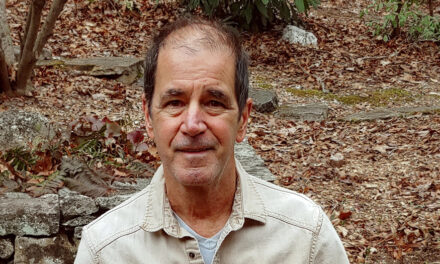

As a creative writing and poetry instructor for more than 40 years, I have spent, and continue to spend, a great deal of time “explaining” poetry, what it means, how it works, how to write it, revise it, publish it. In truth, however, I know that explanation can only go so far, that poetry mostly has to be experienced. And while I think that is true of all poetry, I think it may be especially true of what we consider Eastern forms such as haiku, senryu, tanka, haibun, etc.
Most people are familiar with haiku, although they often have a fairly limited understanding of it, believing any combination of lines with 5, 7, and 5 syllables respectively makes a haiku. Contrastingly, the Haiku Society of America (HSA) states that while “in Japanese a typical traditional haiku has seventeen “sounds” (on) arranged five, seven, and five, today’s poets use a variety of line lengths and arrangements.” Of course, Japanese “on” do not correspond exactly with English syllables, making the usual “rules” of Japanese haiku a bit unwieldy in English. The HSA website explains that “some translators of Japanese poetry have noted that about twelve syllables in English approximates the duration of seventeen Japanese on.” So, given that difference between the basic phonemic structure of Japanese and English, along with centuries of experimentation and refinement, their definition of English haiku today is “a short poem that uses imagistic language to convey the essence of an experience of nature or the season intuitively linked to the human condition.”
I have told my students for years that poetry is to some degree the art of white space, and nowhere is that more true than in haiku, as the poem typically provides merely an image or two, leaving room for the reader to fill in the seemingly empty space with significance. Less familiar than haiku is the related Japanese form of haibun, which offsets concise, imagistic prose (typically fewer than 300 words) with haiku. With its combination of haiku and prose, haibun both partially fills in that white space by providing a degree of comparative context, and partially enlarges that white space by expecting the reader to explore the connection between the prose and the haiku.
The website, Contemporary Haibun Online, advises “think of [haibun] as dialogues—between prose and haiku . . . . both partners in this dialogue expand upon the other’s thoughts and images to create connections that resonate beyond what they can say alone. A reaction occurs, and they become more than the sum of their parts.” Haibun, like much haiku, usually center on personal experiences, nature, travel, or the intersection of those, and features objective observation with a sometimes understated moment of emotional insight, often expressed in the haiku.
First developed by Basho, in the late 17th century, as exemplified in his book, Travelogue of Weather-Beaten Bones, the practice of haibun was continued by numerous Japanese haiku writers, including perhaps most notably Kobayashi Issa in his early 19th century book, The Year of My Life, a journal-style collection of haibun reflecting on themes of poverty, personal loss, and the beauty of small, everyday details. Like much of Issa’s work, the collection is known for its humor, compassion, humanity, and vivid portrayals of daily observations and experiences.
And, as the website mentioned above indicates, the practice continues today as well. So, I could at this point launch into an attempt to explain haibun more fully, but you can do that on your own by visiting the websites mentioned here and by reading the work of Issa and Basho already named. Instead, I would rather return to where I started, to the assertion that experiencing a good haibun might be more instructive than too much discussion of the form.
I have the great honor of facilitating Hickory’s participation in Poetry in Plain Sight (PiPS), a 10-year-old NC Poetry Society sponsored program that places poems on 4 attractive posters each month in shop windows in 23 NC cities across the state. In Hickory, those posters are placed in the windows of Taste Full Beans Coffeehouse, Patrick Beaver Memorial Library, Hickory Community Theater, and Hickory Wine Shop.
The poems for May include a wonderful haibun from NC Haiku Society officer, Dave Russo, of Sparta, NC. I chose to post that one in the window of my coffee shop downtown, and although I’m including it here as an example of haibun, I hope you’ll come by the shop to see it beautifully displayed on the PiPS poster, and that you’ll visit the other PiPS display locations to see this month’s other selections as well.
How Oak Trees Spread Across North America
It was long after the split of gravity and light. Proteins twisted from lava under the sea. Breathing was invented. Some arms became wings. It began to seem that toads should lay eggs: coiled and clear, with live black centers.
It was easy, then, for Blue Jays to come along. Mobbing the acorns from the first few oaks. Scattering to stash them under roots and leaves, in tree hollows and moss beds. According to the wind, the warmth of the sun, and the depth of the urge to hide precious things.
vernal pool
the slow calligraphy
of horsehair worms.