

Just on the heels of the Declaration of Independence, the Second Continental Congress had to decide how the 13 former British colonies would rule themselves. In the summer of 1776, the Provisional government of the United States of America got down to the business of structuring a system they called “the Articles of Confederation and Perpetual Union.” During the war and immediately after this governmental organization was used to replace the leadership of the crown and Parliament, which had broken down, thus the war.
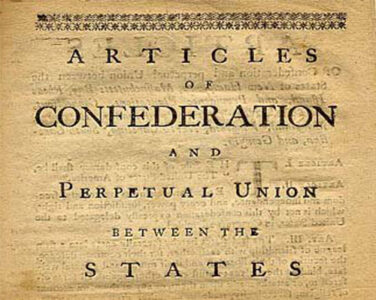
Photo: The original creation for a system of U.S. government, later scraped.
A member from each colony joined a committee to create the new structure. In the document, the name of the nation was established, and declared its purpose was to “enter into a firm league of friendship with each other (the states), for their common defense, the security of their liberties, and their mutual and general welfare, binding themselves to assist each other, against all force offered to, or attacks made upon them, or any of them, on account of religion, sovereignty, trade, or any other pretense whatever.”
Virginia was the first to sign on, on the heels of the document’s completion in 1777. North Carolina ratified participation the following spring. For the rest of the war, and for several years after, the Articles stood as the binding system of government. However, it didn’t take long for weaknesses to reveal themselves.
In the Articles, the individual states held all the power. The federal government was at the mercy of the states for funding with little real power to enforce anything. Plus, changing the articles was next to impossible with a unanimous vote necessary for any alterations. Try making that work in a system where anyone has the right to say ‘no.’ Not much room for discussion after that.
By 1786, the Continental Congress recognized some changes had to be made. They got together to amend the document but soon realized that the Articles did not work, no matter how many alterations to the original were attempted. Ultimately, they decided a scrap the old system in favor of something completely different. A new apparatus was necessary, with strong federal control, essential if anything was going to get done.
It’s understandable why the Founding Fathers crafted the original system as they did. Rebounding from autocratic rule that refused to share power, they first designed the United States government to be without teeth, leaving the real power to the states. They soon realized their mistake.
The architects of the newer incarnation were Alexander Hamilton, James Madison and John Jay. First, they weighed a number of options to create a federal Constitution that fixed the issues of the Articles and instituted the system we still use today. Then, they went out to sell their ‘new and improved’ government. Before ratifying, NC and a few other states wanted rights specifically named which helped bring about the Bill of Rights. Once 9 of the 13 states said yes, the new Constitution replaced the old Articles, creating a principle by which we still live, majority rule.
Perhaps the road to the United Constitution is a hallmark of what it means to be an American. If we don’t get it right the first time, we keep trying until we do. Over 250 years, we have made our share of mistakes. And during that time we have made strides to correct those missteps in the pursuit of a “more perfect Union.”