

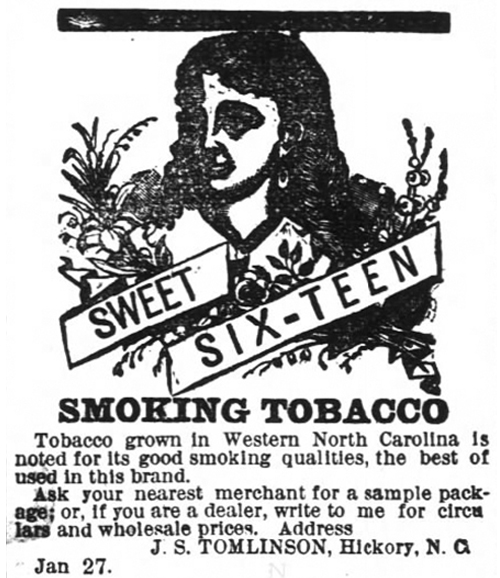
Photo: An advertisement for Sweet Sixteen, manufactured in Hickory.
As the city of Hickory struggled to grow after it incorporated in 1870, one of the new opportunities that sprang up was tobacco. The Piedmont Press reported it this way:
“There are now four tobacco factories in this place (Hickory) in operation. The raising of tobacco in the surrounding community and the manufacturing of it in the town is what the Press has been advocating for several years, but our hopes were not realized until quite recently (1878). Throughout the Piedmont section there is now a great deal of the week grown and some of the farmers have became skilled in its culture and are raising very fine crops.”
Just like down on the other end of the Piedmont, the land proved to be suitable for growing tobacco, which is not an easy process. Plants have to be incubated until spring when they are transferred to the fields. Bugs and strength-sapping leaves are menaces to a strong plant, which when cut, requires a lengthy curing process. Nonetheless, farmers were finding their “weed” marketable, thanks to a number of factories buying their crop and turning it into packages suitable for smoking or chewing.
The first factory came in 1882, on the corner of First Avenue, NW, somewhere near the old WIRC studios. The second was Keach, Davis and Company. They produced a smoking tobacco called the “Carolina Indian Chief.” The company built a two-story factory but was only in business six years before folding. Next came J.S. Tomlinson. His brand was called “Sweet Sixteen” and though he too was gone by 1885, for a while Hickory was coming to be known as a tobacco town. Another short-lived variety was “Cinderella” smoking tobacco which only lasted a few years.
Toward the end of the 19th century, cigars were also manufactured in Hickory. “The Carolina Special” was produced by Julius Flaum downtown at the location of Bisanar’s Jewelry on Union Square. A.W. Marshall started one, too. He called his product, “Marshall’s Favorite.” Over the years a few more cigar makers tried and failed to establish themselves in Hickory. What happened?
We can thank James B. Duke down in Durham. Once his American Tobacco Company grew big enough to control the market, western North Carolina production withered. Duke pioneered the production of cigarettes which became very popular among smokers. Plus, his tobacco “trust” required other manufacturers operate in a way Duke demanded or be put out of business. Ultimately, the Supreme Court found the trust to be in violation of antitrust laws and was broken up, but by then Hickory had moved on to other products like furniture and hosiery to substitute for the once promising market of tobacco.